Scaling Beyond One Agent? Here’s Where Most Teams Get Stuck


A monolithic agent that degrades under its own complexity, or a maze of specialists with no coordination? Agentforce Multi-Agent Orchestration offers a better choice.

A new pattern is emerging as enterprises expand from one AI agent to several. It starts with a jack-of-all-trades agent handling every task across every domain. As new domains are added, the agent has to reason across an ever growing set of instructions and soon begins to struggle to understand what you’re asking it to do and how to do it. It might start to hallucinate or route customer requests to the wrong subagent. To diagnose what went wrong, you’ll have to read through instruction blocks that could easily be thousands of lines long.
From there, organizations do the sensible thing and split the monolithic agent into a team of specialists, each with a narrow scope dedicated to a distinct domain. Specialist agents hallucinate less, deliver more reliable results and can each run the model best suited to their domain. But this creates a new problem. Now, end users have to navigate a growing list of agents, figure out which one to talk to, and repeat themselves any time they have to switch over from one to another. If something goes wrong in the handoff, engineers have to untangle a complex web of routing decisions to get to the root cause.
To get the best of both worlds — a unified agentic experience that can reliably tackle the full breadth of what customers might throw at it — organizations take the next logical step: deploy a front door orchestration agent that can accurately identify any request and route it to the correct domain agent. But as many companies are already discovering, not all orchestrators are created equal.
Building orchestrated systems with Agentforce
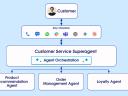
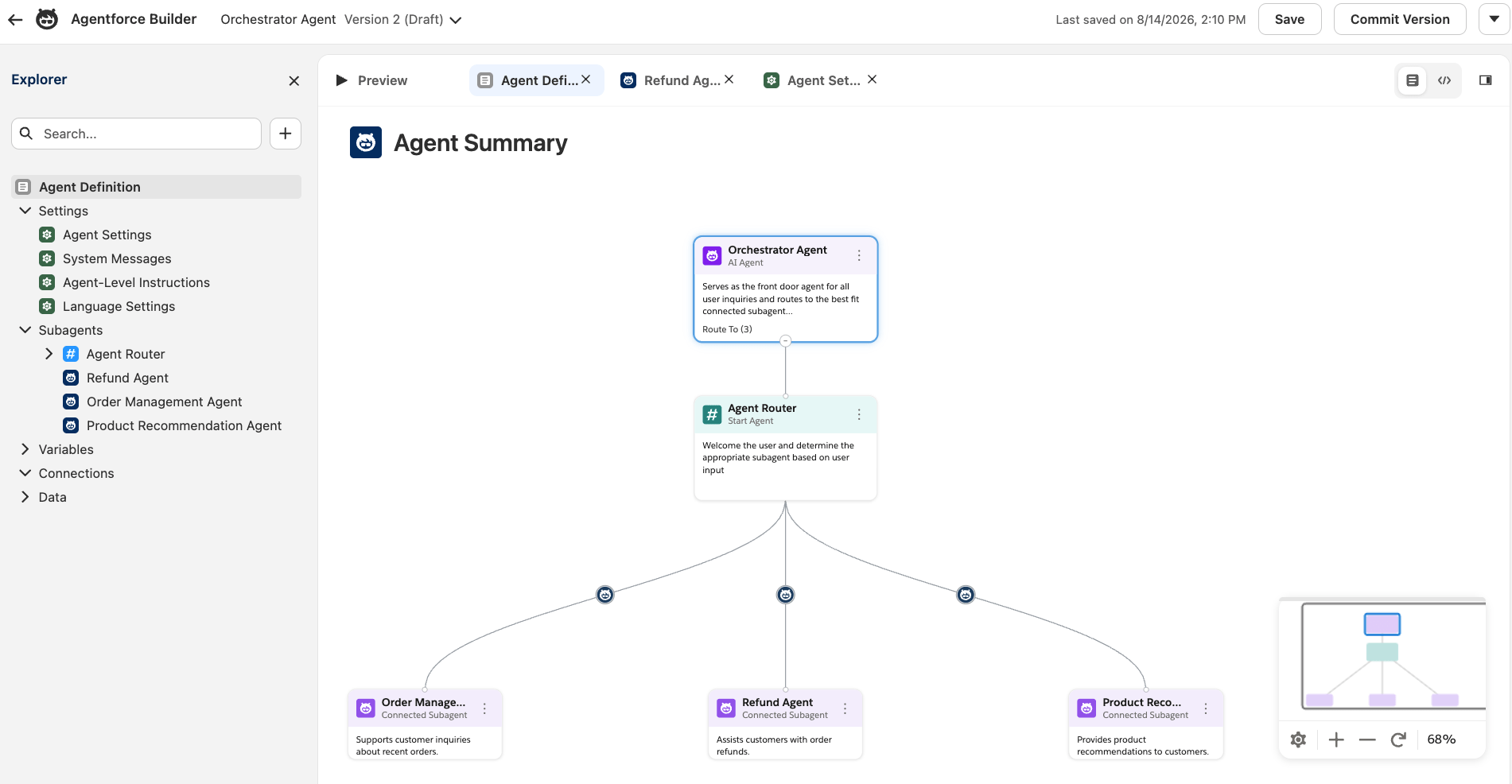
Agentforce Multi-Agent Orchestration, now generally available, gives enterprises a single orchestrator as the entry point across every agent they deploy, and the control to ensure critical workflows run the same way every time. The orchestrator takes each incoming request and decomposes it into component tasks, reads the intent behind each, then routes each task to the agent best equipped to handle it. Once the subagents are done working, the orchestrator consolidates their outputs into a unified response. The orchestrator reads the available agents and their descriptions before it routes, ensuring every task reaches the right agent.
Upcoming features currently in pilot will extend orchestration capabilities to A2A-compliant third-party agents from non-Salesforce vendors, such as Google or AWS. This unlocks new use cases that require agent collaboration across platforms, and reaffirms Salesforce’s commitment to an open, interoperable ecosystem.
Orchestration solves one problem. Control is the harder one
What separates an orchestrator that works in a demo from one that holds up in production is whether every handoff stays accountable and critical workflows run the same every time. While probabilistic routing will usually make the right call, 95% reliability isn’t good enough for something like an order return or a critical compliance check. These processes need to work the same way regardless of how a customer phrases a request or how an LLM might parse it. For these kinds of mission-critical tasks, Agent Script lets builders declare the routing path explicitly rather than leaving it to inference.
Control also means knowing what happened when something breaks. With a single agent, there’s one place to look. But once a request has moved between several specialist agents, the problem could sit in any of the handoffs. Finding the root cause means reconstructing the whole path: which agent picked the request up, where it routed next, and why it made that call. Agentforce Observability surfaces the full picture through updated session tracing, with every multi-agent interaction captured turn-by-turn. When something breaks, engineers can follow the chain back to understand which agent handled each turn, where it routed and why.
To see how your organization can start leveraging Multi-Agent Orchestration today, click here.