Building an AI-Powered Business in 2025: Six Key Questions for Executives
Co-authored by Frank Fillmann, EVP & GM Salesforce, ANZ and Geoffrey Moore, consultant, best-selling author and keynote speaker


Co-authored by Frank Fillmann, EVP & GM Salesforce, ANZ and Geoffrey Moore, consultant, best-selling author and keynote speaker


This white paper aims to help CEOs, their leadership teams and boards articulate the strategic preferences essential for crafting an effective artificial intelligence (AI) strategy. It highlights the use cases that deliver real ROI at pace, both for efficiency gains and pursuing real competitive advantage.
Our goal is to support Australian and New Zealand businesses to move beyond experimentation to genuine AI-powered business transformation as we shift from the ‘art of the possible’ to the ‘art of the practical'.
The race is on to deliver on the promise of enterprise AI. Global AI spending is expected to reach $632 billion by 2028, according to IDC . McKinsey estimates that AI will generate $2.6-$4.4 trillion in value annually, and the vast majority of that value, 75 per cent, is expected to come from front-line functions, such as customer operations, sales and marketing. McKinsey also estimates that AI could boost Australian labour productivity by up to 1.1 per cent a year by 2030.
We believe the most pressing challenge right now is to determine what role AI should play in next year’s operating plan. Enterprise leaders need to secure clear, well-informed answers to the following six questions in order to build resilient future-proofed organisations that can both endure and adapt.
C-suite executives in Australia and New Zealand are feeling pressure from all sides. Boards expect to see how all this experimentation will materially impact the fundamentals of the business. Customer expectations are rapidly shifting in response to the experience of consumer AI, making traditional processes seem clunky and unnecessarily bureaucratic. Meanwhile, the absence of industry best practices makes it hard to know how much AI is enough, to keep up with competitors.

Many CIOs are finding the pace of innovation overwhelming, and this is understandable. We have already moved to agentic AI less than two years after generative AI went mainstream, and excitement about the technology is uncovering an enormous variety of potential use cases.
What executives crave is a coherent strategic roadmap, before business units or individual employees start creating workarounds, and shadow AI starts generating material risks, rather than material gains. This is especially pertinent for regulated industries and high-profile companies, where trust and reputation is paramount.
Wherever they look, CIOs see unresolved data challenges - the hangover from unfinished digital transformations - threatening to derail progress. Ironically, CIOs report seeing a mismatch between AI potential and data readiness in those very same customer-facing functions that promise to deliver the most value.
What is becoming clear is that a technology strategy can’t be created in isolation. Enterprise AI demands a serious consideration of what an AI-powered version of the organisation should look like. As a result, A/NZ executives are looking to their CEO to describe the kind of AI transformation they envision for their companies.
For their part, CEOs need strategic frameworks that will allow them to weigh the trade-offs unique to their industry and to their market. They want to know how to set an appropriate ambition, prioritise investment, assess the competitive threat, realise productivity gains, and build capacity and adaptability. They also need to be able to effectively communicate the rationale for these decisions to their board, executive team, workforce and stakeholders.
This white paper combines Geoffrey's methodology and thinking with Salesforce's expertise in enabling agentic AI, into an approach that every exec can use. We hope this provides a first step to help you develop a robust enterprise AI strategy for the year ahead.
AI brings three game-changing capabilities to the table that can be incorporated into a 2025 operating plan:
Using time-series analysis, trend detection, and statistical quality control, predictive AI has delivered decades of success, albeit limited to local systems where the data is readily available, running algorithms developed by analytics experts, monitored by operators who intervene when control limits are exceeded.

While natural language processing has been around for several decades, the interactive conversational capabilities of generative AI expand its applicability exponentially. This is the game-changing breakthrough that is getting all the attention today. That said, for the time being, it is primarily deployed in human-in-the-loop co-pilot applications because the quality of its answers still requires review before being acted upon.
It is still early days, and some of the hurdles it must overcome include a reengineered approach to data management, a rethinking of the boundaries between humans and machines, and an agreed-upon governance standards for ethical use. Agentic AI is the only AI technology that will release trillions of dollars of trapped value when deployed at scale, and as such is the one that deserves the most attention.
the primary requirement is a comprehensive transaction history, both at the database level (for content) and the log file level (for time-dependent correlations). The infrastructure must refresh this data on a consistent and timely basis and ensure its quality and integrity. Where multiple disparate systems are involved, as is frequently the case, the infrastructure must extract, aggregate, and normalise all participating data sources to enable AI correlations to proceed properly.
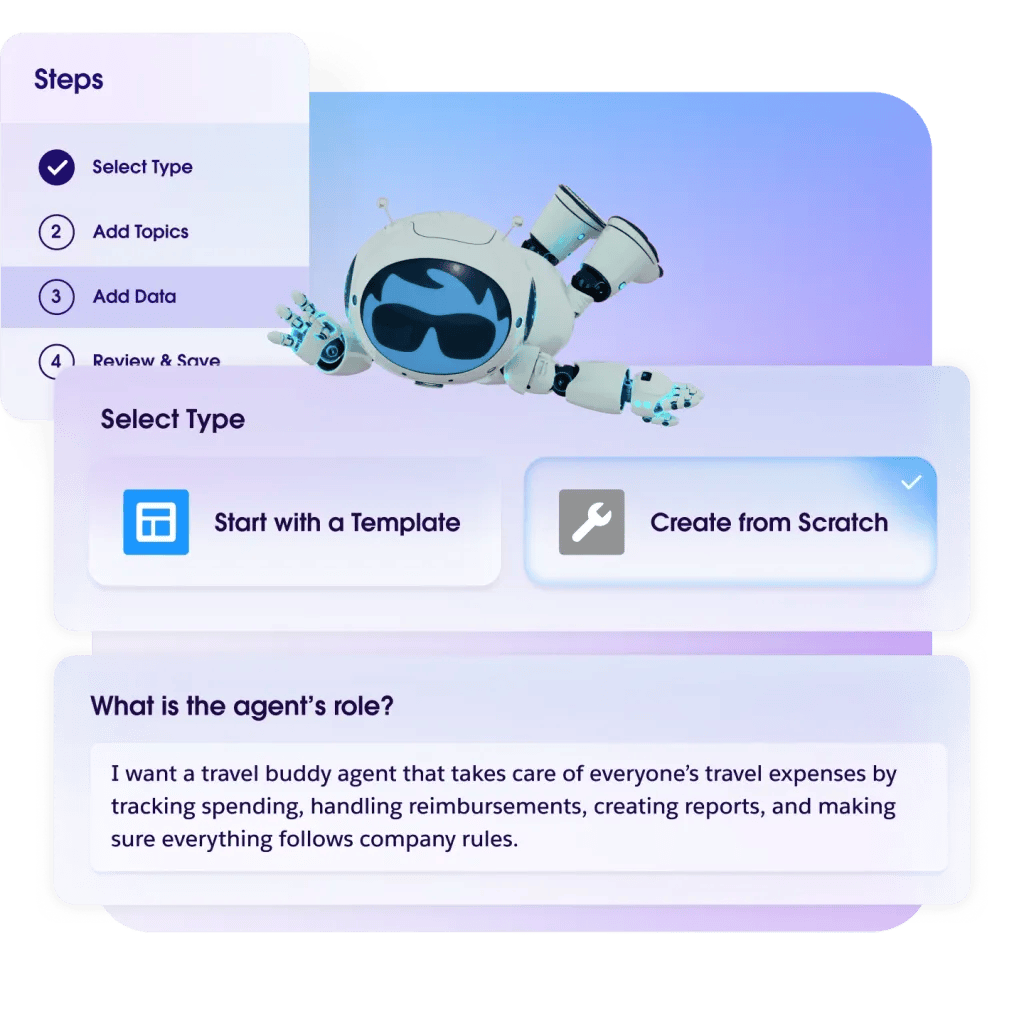
the primary requirement is to have a corpus of validated information suitable for exposure to end-user queries. Then one needs to licence a Large Language Model to provide the conversational interface and a prompt management system. This can assist end users in providing the AI with useful context, as well as developing a library of increasingly effective and efficient prompts for recurrent use.
all the infrastructure requirements for both predictive and generative AI must be met. In addition, there needs to be automated workflows that can be invoked by AI agents via application programming interfaces (APIs). Further, agent-building capabilities need to be provided to both subject matter experts and IT professionals so that the system can adapt to changes effectively and efficiently.
Over two decades ago, Salesforce pioneered the first multitenant cloud platform, setting a precedent in the industry. Since then, Salesforce has significantly expanded its footprint, and now serves over 150,000 customers from various industries and regions.
Four years ago, Salesforce embarked on a mission to completely transform its platform from the ground up. The launch of Agentforce at Dreamforce 2024 represented the culmination of this extensive effort.
With the groundwork laid, we now have the right conditions for accurate, governable and sustainable enterprise AI use cases.
Any AI system is a combination of UI + Model + Data. Collectively, the features of our platform above materially impact the viability of enterprise AI, by improving the performance of AI systems at every level.
the use cases will likely involve process management where there is a continual flow of transactions that need to be monitored or a given set of control limits that needs to be maintained. Optimising transportation and logistics is a good example, along with digital marketing and financial crime detection.

the use cases will likely involve connecting people with questions to applications with answers. Contact centre services are a prime example, as is personalising in-store retail interactions and providing managers with ad hoc business intelligence.
the use cases will likely involve offloading low-value repetitive procedures for efficiency gains or accelerating critical workflows for gains in effectiveness. Level one customer service enquiries are an example of the former. Improving customer and/or employee experience with faster and more accurate responses is an example of the latter.
Every system is ultimately constrained by one or more gating factors. If they can be removed, the system will elevate its performance up to the point where it encounters the next set of constraints. The delta in performance represents trapped value.
The history of computing is one in which constraint after constraint has been removed by introducing a new category of applications. Automated record-keeping and reporting, office automation, real-time transaction processing, the internet, ecommerce, mobile computing, the worldwide web, cloud computing, software-as-a-service — all released extraordinary amounts of trapped value.
Every enterprise relies on a set of core systems to run its operations, and every one of those systems is gated by some constraint. The purpose of trapped value analysis is to identify the constraints that are trapping the most value in your enterprise and match them up with innovative applications that can eliminate them.
With respect to predictive AI, inventory management represents a perennial target (items out of stock), as does field servicing (low-value truck rolls), equipment maintenance (unplanned downtime), ecommerce (empty shopping carts), and digital advertising (click fraud).
With respect to generative AI, retail interactions are a prime target (lack of sufficient personalisation), as are consultative engagements (lack of data or expertise in the moment of engagement), public services (dropped calls on hold), and account management (failure to follow up in a timely way).
With respect to agentic AI, targets for trapped value recovery from low-value-added repetitive tasks include procedures for regulatory compliance, top-of-funnel B2B sales lead qualification, customer support questions, computer code reviews, regression testing, employee benefits enquiries, and drafting emails. Targets for trapped value recovery from underperforming high-value workflows include timely ad hoc access to knowledge management repositories, customer history, specialised expertise, and real-time execution capabilities.
To get the ROI from an investment in AI clearly in focus, it helps to look at the enterprise through the lens of zone management. In this framework there are four zones of activity, each with its own operating model, and each of which will be looking for a different ROI from an AI investment:
This is where you sell what you make and make what you sell. It is where you deliver your value to the world. ROI potential comes from increases in competitive advantage and customer success leading to higher win rates, better retention, greater market share, increased leverage over ecosystem partners, and lower discounting. The critical metrics focus on effectiveness.
This is where you deliver the systems that allow the Performance Zone to operate effectively at scale. ROI potential comes from faster response times, better quality, more accurate information, successful compliance, and lower costs. The critical metrics focus on efficiency.
This is where you engage with next-generation disruptive innovations, be they in technology, business model or operating model. ROI potential comes from making better-informed decisions on which ones to invest in, and which to ignore. The critical metrics focus on time to adopt and problem/solution fit.
This is where you go to make a material change either to your portfolio of offerings, your operating model, or your business model. ROI potential comes from transitioning from being a marginalised legacy player to being an active participant in the next big thing. The critical metrics focus on inertial momentum getting to a tipping point.
The key point here is that because the missions for each zone and their metrics of success are so different, it is critical for executive management to put each AI initiative in service to one and only one zone. When two or more zones both want to put their hands on the tiller, the boat tends to travel in circles.
Despite almost every company making significant data strategy investments, 94 per cent of business leaders feel they should be getting more value from company data. Only 39 per cent of companies believe they are successfully turning data driven-insights into competitive advantage.

The challenge lies in the complex data strategies companies are forced to employ. With an average enterprise using over 1,000 applications, those who have attempted to organise their data develop massive and complex data ecosystems. While successful in centralising data from an array of sources, these ecosystems are difficult to operationalise as the data remains static and stuck in back-end solutions not designed to activate data within the everyday workflows and applications business teams use to engage with their customers. They fall short at the “last mile” of activation, leading to poor customer experiences driven by disconnected or inaccessible data.
Our customers have shared stories that illustrate this problem more clearly. From marketing campaigns that miss their target due to delayed data, to service alerts that blanket entire regions instead of focusing on only the affected customers, to sales reps from the same company unknowingly cold-calling the same buyer multiple times in a day, these issues stem from a lack of accessible, actionable data.
Data Cloud connects all of a company’s data to Salesforce's foundational metadata layer, offering a shared language used by all applications, unlocking a range of user-friendly tools that make data easier for everyone to work with, especially AI agents.
Focusing on the data problem can, however, drive companies into a monolithic approach to building AI capability, or delay it indefinitely. 'Let's solve our data problem first, then we’ll start our AI transformation’, is a tempting strategy, but it delays action, delays learning and workforce engagement, and strongly biases the organisation to invest only in AI initiatives that fit within the Productivity Zone.
Organisations can get initiatives in other zones moving faster, and can unlock the power of a multi-speed transformation, by thinking in terms of data products. You can think of a data product like a small brain, specifically created for an AI agent, so that it knows just what it needs to know to do its job. The key, however, is not to build a separate data infrastructure for each of these brains, but to virtualise that infrastructure, and the associated metadata, through Data Cloud.
One of the biggest benefits of this approach is this: just as Agent Builder empowers business users to take responsibility for defining an agent’s role and instructions, Data Cloud allows those same business users to share responsibility for the relevance and reliability of the data that informs that agent’s behaviour. Here we are applying a principle we’ve lived by for over 20 years: you get faster, more effective digital transformations when you bring control closer to the business and closer to the customer, and you do that by enabling configuration through clicks, not code.
Even better, this approach frees up rare and expensive data science and engineering resources to focus on those incubation zone initiatives that are truly unique to your organisation’s competitive advantage.
The answer to this question depends on how far the disruptive innovation has progressed through the technology adoption life cycle in your geography and industry. There are four stages in the life cycle that matter, and each one comes with its own imperatives:
This is a time when disruptors need to act fast in order to gain first-mover advantage. Exploiting this kind of opportunity is best suited to start-ups funded by venture capital and unencumbered with any other obligations. It is not critical for established enterprises to participate at this time, but if there is interest and bandwidth, they can activate their Incubation Zone to explore the possibilities.
For a handful of use cases, it is important to act fast, but not for technological reasons. Rather, because there is an urgent need to address a mission-critical business process problem and the current solutions are simply not cutting it. Start-ups can focus on a single use case in a single industry in order to put their business on a solid footing, no longer dependent upon raising another round of funding. Established enterprises can free their operating model from a bottleneck that is bringing down their overall performance, initially by tackling it in their Incubation Zone, and then - once the solution has proven out - transitioning to either the Performance Zone or Productivity Zone, depending on where the bottleneck resides.
This is when the technology has caught on, adoption is accelerating like crazy, and either you are going to catch the wave or the wave is going to catch you. At this stage, everyone must act as swiftly as they can. Vendors need to capture as much market share as possible, and customers need to modernise their operating models as fast as possible. The pressure is on the Productivity Zone to accelerate deployment and adoption, and on the Performance Zone to deliver value realisation. If inertial resistance is stubborn and you are falling behind, this warrants activating your Transformation Zone.
The technology has now become reliable infrastructure, and the urgency to act is replaced with the opportunity to optimise. This is a great time to do a comprehensive end-to-end trapped value analysis of your entire enterprise, leveraging Six Sigma and DMAIC disciplines, to identify and target processes that have been holding you back for years. Here the Productivity Zone can shine, and over the technology adoption life cycle, the bulk of the ROI is likely captured at this stage.
The key point here is not to maximise the absolute speed with which you act, but rather to act with the appropriate speed given your situation. Different personas will have very different senses of what that speed should be, so this requires substantial discussions to get the entire team in sync.
Australians and New Zealanders have a unique relationship with digital innovation. Business leaders in A/NZ often approach new technology cautiously.
They are keen to ensure that it’s aligned to the needs of customers, market dynamics, the risk appetite and governance capacity of the organisation, as well as the values and culture that animate and engage the workforce.
At the same time, Australia and New Zealand have a history of rapid adoption once perceived quality thresholds are reached. We saw this in the adoption of internet banking and mobile phones, the transition to a cashless society, and now in cryptocurrency adoption, where Australia boasts one of the highest rates of individual cryptocurrency ownership among comparable nations.
In this context, it’s critical to avoid the expected acceleration in individual demand for AI tools in the workplace from turning into rampant shadow AI. CIOs are seeking their own ‘Spotify moment’, where they can channel the enthusiasm for new consumer technology into sustainable and governable alternatives. Avoiding an online pirated content scenario of virally popular, but inherently risky, personal use.
It’s worth appreciating how unprecedented this moment is. Traditionally, adoption was one of the biggest limiting factors in the success of an enterprise digital transformation. We’ve had 20 years of product and experience design and usability testing to ensure we built systems both desirable and intuitive enough to be adopted. Now we're suddenly faced with too much disorderly adoption too quickly.
Businesses need to find ways to lower the barriers to safe adoption of AI. Here are seven recommendations for how to start:
that have a clear business benefit, and move the organisation forward in its transformation. AI systems should be judged not by the number of parameters they hold, but by whether they remove productivity bottlenecks and deliver unexpected value to customers.
There are no free lunches, especially in this economic and environmental climate. It’s crucial that the AI systems you choose enable you to pick the right combination of capabilities — whether it’s predictive, generative or agentic AI — along with the right model, prompt augmentation, and UI for the job.
We’ve already seen examples of solutions delivering significant cost savings by switching back to a predictive model for a resource-intensive component. We’ve also seen examples of solutions that avoided an expensive governance challenge by changing the UI to avoid it altogether. Choose the system that will allow you to balance accuracy and power against the total financial and carbon cost of ownership.
No-one knows better than your employees where sophisticated and powerful technologies add significant value, and where a simple workflow is good enough. The sooner you engage them in refining the problem to be solved, the sooner your AI investments may start generating outsized returns, and you build trust with employees along the way. Inviting a wider employee community into the process is also a great way of mitigating the risk that can arise if there is less diversity in your data science team.
Start the way you want to continue, by exposing employees to what is possible, as early as possible, in the actual context of use. In doing so, you’ll not only deliver value faster; you’ll learn what sort of accuracy matters, and what level of autonomy is manageable. By doing this, you’ll encourage a more intelligent backlog of use cases by building a familiarity with common technical or data constraints.
Your AI systems should help protect the integrity of your data, and your customers’ privacy. They should make it easier to enforce roles, scope and guardrails for agents. They should also allow you to create the kind of mindful friction that will encourage safe and responsible use at critical decision points.
so that AI responses and actions can be informed by what the data means and which data matters to the business and its customer relationships. Ensure that the data informing the agent or assistant responses is transparent and intelligible to the business unit that the AI system is serving.
Provide your employees with opportunities for self-paced learning, and remember that the right solution should not only leave your staff with more time, but with a greater understanding of how to leverage AI tools safely at work. Get them involved in testing so they can see how AI systems can fail. It will help them appreciate the value of data science expertise, and when they need it.
To recap, here are the six questions you need to develop clear answers to in order to incorporate AI effectively into a 2025 operating plan:
The advisory services and account management teams at Salesforce are deeply engaged in helping our customers embrace AI as part of their core infrastructure. They are experts at answering these questions and pressure-testing plans to apply AI to trapped-value use cases.
We would welcome an opportunity to engage with your team to help you make your plan a huge success.
Fisher & Paykel, a leader in luxury appliances, is revolutionising its customer service by implementing Agentforce to provide high-quality support befitting its premium brand.
Fisher & Paykel is using Salesforce's AI, data, and CRM tools to enhance customer experiences:
Our customers expect efficient and personalised experiences when they engage with our brand - experiences that mirror the luxury of our products. With Agentforce, we will enhance our partnership with Salesforce, deploying autonomous agents that will deliver for our customers when they need us most, while simultaneously driving sales.
Rudi KhouryChief Digital Officer, Fisher & Paykel
A leading online marketplace for trade services, hipages, has teamed up with Salesforce to enhance experiences for tradies and streamline internal operations. Its using Agentforce, Data Cloud, and Service Cloud to fix problems caused by legacy systems and improve data visibility.
This transformation has led to better engagement between customer-facing teams and hipages’ tradesperson community. Employee productivity has also improved by reducing manual processes and consolidating systems.
By leveraging Salesforce to drive a data and AI transformation hipages can:
Agentforce and Data Cloud will help us connect better with our customers and tradies, navigate data storage and access challenges, and ensure our team members no longer need to 'swivel chair' from system to system. We chose Salesforce as our platform to support our product-led approach and make the working life of our staff and tradies as easy as possible.
Jeremy BurtonCTO, hipages Group


Frank is Executive Vice President & General Manager, Salesforce Australia and New Zealand. In this role, Frank is responsible for ensuring Salesforce delivers on its values of trust, customer success, innovation, equality and sustainability for both our customers, partners and community.
He has been with Salesforce for over 12 years, occupying roles across a broad range of portfolios, including Tableau, Business Services and Professional Services. Prior to Salesforce, Frank held senior positions with companies including Amazon Web Services and IBM.
Frank is passionate about giving back to the community and helping others be successful. He co-founded Salesforce Warmline Connections, enabling and supporting women and other underrepresented groups to have more access to networking and opportunities.
He lives in Sydney, Australia, with his wife and their four children.
A consultant to the high-tech sector for over 35 years, Geoffrey Moore is a best-selling author, renowned public speaker, and trusted advisor recognised for his profound understanding of dynamics of disruptive innovations and the strategies to capitalise on them. He balances his consulting between venture-backed start-up companies and established public enterprise.
As an author, Moore has published seven best-selling books addressing the marketing, strategy, and organisational challenges that are triggered by disruptive innovations. His first book, Crossing the Chasm, published in 1991, has sold over 1 million copies, been translated into more than a dozen languages, and to this day, now in a third edition, represents the go-to-market playbook for entrepreneurs seeking to grow their customer base beyond the early adopters to the pragmatist mainstream. His most recent work, Zone to Win, written in collaboration with the executive teams at Salesforce and Microsoft, addresses the challenges publicly held enterprises face, balancing commitments to profitable but aging legacy lines of business with promising next-generation opportunities that require deep investment to get to scale.
As a keynote speaker, Moore delivers between 20 and 40 speeches each year, specialising in thought leadership topics that help audiences better grasp the potential impact of emerging technologies on their industries and enterprises. The phrases and metaphors he introduces have become part of the language of high-tech one often hears about: chasms, tornadoes, systems of engagement, or the hierarchy of powers.
As an advisor to CEOs and their executive teams, Moore has worked with some of the most iconic high-tech firms, including Adobe, Autodesk, Cisco, HP, Microsoft, and Salesforce. He has also helped emerging companies rise to prominence, including Aruba, Box, Docusign, Gainsight, and Proofpoint. Advisory efforts include strategy check workshops, thought leadership narratives, executive development, and organisational design.
The authors would like to thank Justin Tauber, General Manager Innovation and AI Culture, Salesforce for his critical contribution to this white paper.
This report is for informational purposes only and is subject to change. While we endeavour to assist our customers in their AI transformation journey, Salesforce, its subsidiaries and employees, and Geoffrey Moore, (collectively, ‘We’) do not warrant or guarantee the accuracy, suitability or completeness of any information, links, or other items in this report. To the extent permissible under applicable laws, We exclude liability for any representations or warranties made. As this is not legal or professional advice, we encourage you to obtain your own prior independent legal and professional advice, and to make your purchase decisions based on your unique needs and the Salesforce products and features that are currently available to you.
The report contains the trademarks, confidential and proprietary information of Salesforce, Inc, its subsidiaries and Geoffrey Moore, the respective owners reserve and retain all rights, titles and interests. Salesforce customer stories reflect the experiences of actual customers, but your experience may vary.
Take a closer look at how agent building works in our library.
Launch Agentforce with speed, confidence, and ROI you can measure.
Tell us about your business needs and we’ll help you to find answers.