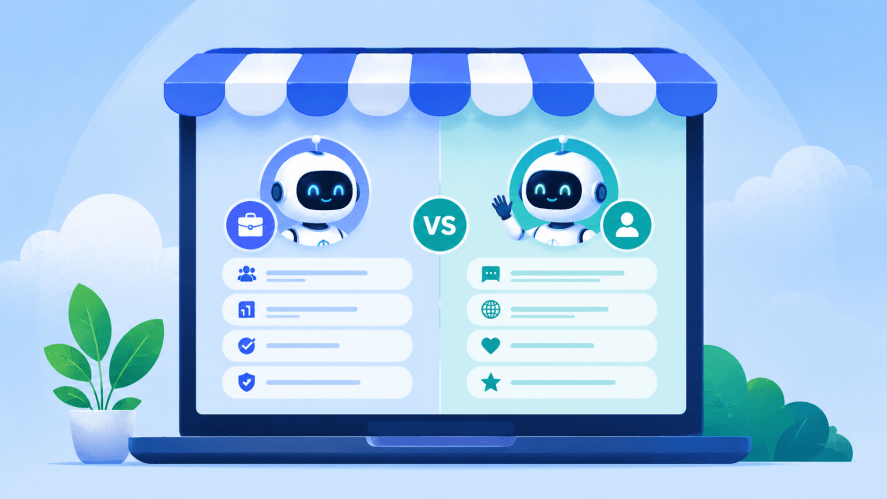

So, did you know that not all artificial intelligence (AI) agents are built the same? There are two main types — employee agents and customer-facing agents — and knowing the difference can help your team get the most out of AI from day one.
Whether you’re a founder trying to keep up with a full pipeline or new to AI, you could likely use some help running your business. That’s exactly where AI agents come in — and three out of four small businesses are already investing in AI, with those adopting it seeing significant returns. Let’s break it down.
What are employee agents?
Before your team can put AI agents to work, it helps to understand what each one does and how they benefit you. Let’s define both:
An employee agent is an internal tool. It supports your team — sales, service, marketing, and operations — by making their jobs easier and more productive. Think of it as a personal assistant for every team member: It might summarize a lengthy customer record, draft a follow-up email, surface the right information from your knowledge base, or answer a policy question — all without anyone having to dig through tabs or wait on a colleague. These employee agents live right inside your business operating systems — right inside your workflows, for example in Salesforce CRM, Slack, and integrated apps.
What are customer-facing agents?
A customer-facing agent is external. It’s what your customers interact with directly — answering questions, resolving cases, managing orders, and troubleshooting issues across self-service portals and messaging channels, 24/7.
Unlike old-school chatbots that rely on rigid scripts, these agents use generative AI (GenAI) to craft responses that understand context and match your brand’s voice. When something’s too complex to handle autonomously, they hand it off to a human — seamlessly. These AI agents also live in your business tools, and often are trained and deployed easily with the right skills.
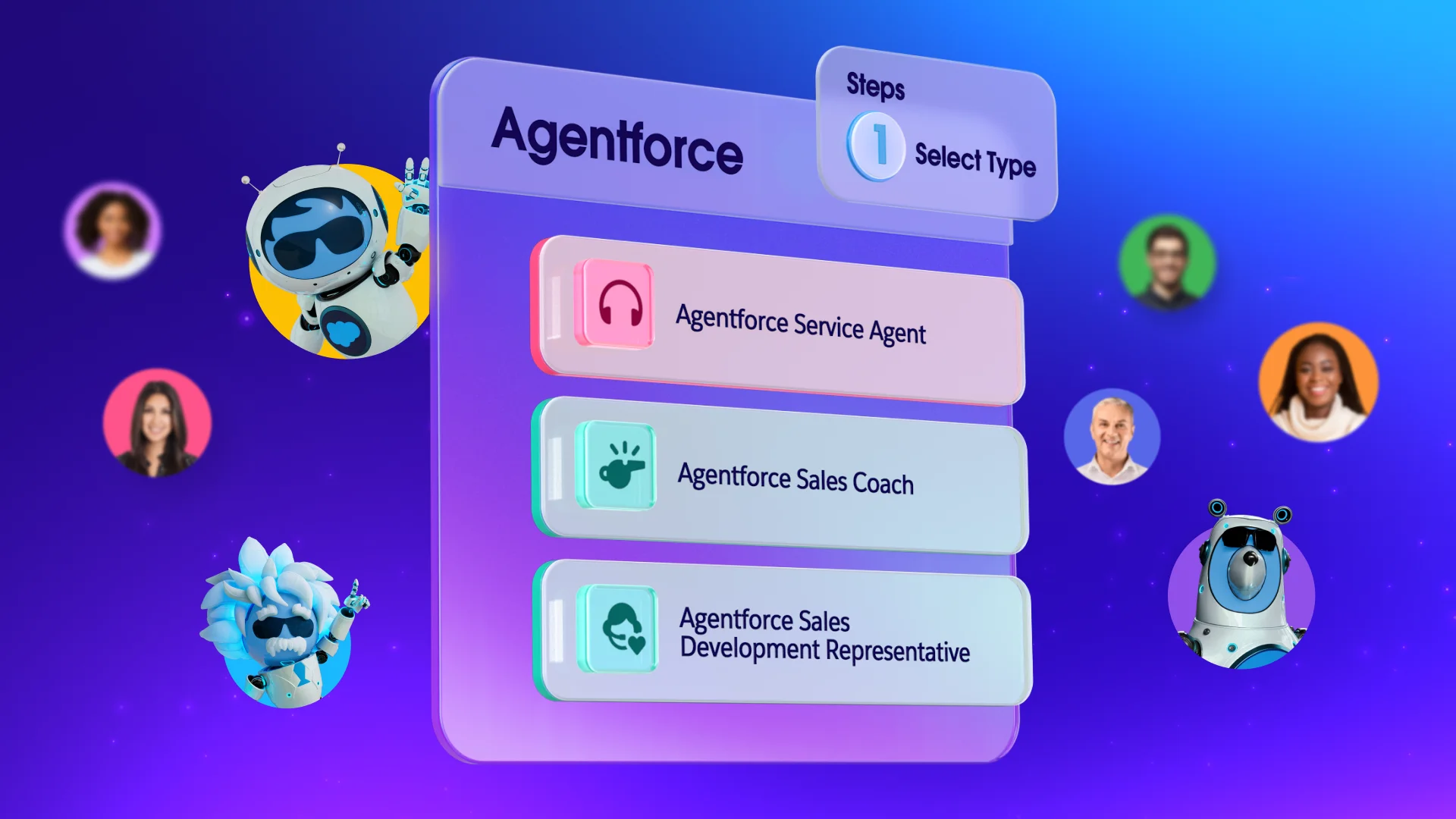
How each type of agent helps small teams
For some small and medium businesses (SMBs) and startups, the biggest appeal of both agent types is the same: Doing more without losing time or resources. But the how looks different depending on which agent you’re deploying.
Employee agents help your team focus on what matters
By automating repetitive tasks — like drafting emails, summarizing records, or routing internal requests — employee agents free your team to spend more time on the work that actually moves the needle. This leads to higher job satisfaction and reduces burnout, which is huge for a small team where every single person counts. These permissions-aware agents use the secure, structured data within your customer relationship management (CRM) platform — like customer history, sales notes, and service cases — to provide highly relevant, contextual assistance.
Customer-facing agents keep your business running after-hours
Customer-facing agents solve the problem of 24/7 support by responding to buyers around the clock — whether it’s answering a product question at midnight or resolving a returns request on a Sunday. They take a deeper dive into AI chatbot responses with complex learning and understanding of your business and customers.
According to Agentforce research, 67% of customers feel frustrated by slow resolutions and nearly one-third of interactions are abandoned — that’s time and revenue your team doesn’t have to lose.
| Agent Type | Features | Capabilities | Benefits |
|---|---|---|---|
| Employee Agents | Internal tool; available in CRM, Slack, and mobile apps. | Summarizes records, drafts emails, surfaces knowledge base info, answers policy questions, automates repetitive internal tasks. | Boosts internal productivity, reduces burnout, increases job satisfaction, provides contextual support using CRM data. |
| Customer-facing Agents | External tool; available 24/7 via CRM self-service portals and messaging channels. | Answers product questions, resolves cases, manages orders, troubleshoots issues, generates on-brand responses, hands off to humans. | Provides always-on support, reduces response times, prevents abandoned interactions, improves the buying experience. |
Do you need one type of agent or both?
Here’s the honest answer: Most growing businesses benefit from using both employee agents and customer-facing agents together.
Start with what hurts most
If your team is drowning in admin tasks, start with employee agents to boost internal productivity right away. If you’re losing customers because response times are slow or your team can’t cover after-hours requests, start with a customer-facing agent instead. The good news? You don’t have to choose forever — you can start small and scale.
They work better together
When your employee agents and customer-facing agents are both grounded in the same CRM data, the whole experience gets smarter. Your customer-facing agent can pull live context from your sales and service records, and your employee agents can pick up exactly where the customer conversation left off.
Businesses that combine both types of agents typically see the fastest measurable return because they touch high-frequency, high-volume interactions across the entire business every day.
Grow Your Business With AI Agents
Learn how autonomous AI can scale your small business for free in our latest e-book.
What makes AI agents different for SMBs and startups
The biggest misconception about AI agents is that they’re only for big companies with big budgets and dedicated IT teams. They’re not.
Both employee agents and customer-facing agents are built on a foundation of trust: When you partner with Salesforce, your data stays protected and is never shared with third-party AI tools. They’re also built to grow with you — whether you’re staying intentionally lean or scaling up operations over time.
Agentforce is a great example of a tool using both agents. It’s the AI platform from Salesforce that powers both employee agents and customer-facing agents — and it’s now built directly into Salesforce CRM. That means you don’t need a separate budget line or a lengthy implementation — you can spin up prebuilt agents right inside the tools your team already uses. Agentforce is accessible and impactful for growing businesses, with agents that are customizable and deeply connected to your existing data and workflows.
Start putting employee and customer-facing agents to work for you
Whether you’re ready to give your team a productivity boost with employee agents, or you want to deliver always-on support with a customer-facing agent, the path forward is easier than you think.
Get started with Salesforce for free or activate Foundations to try out Agentforce today.
AI supported the writers and editors who created this article.
What’s the main difference between employee agents and customer-facing agents?
Employee agents work internally — they support your team with tasks like drafting emails, summarizing records, and surfacing information. Customer-facing agents work externally, interacting directly with your customers to answer questions, resolve issues, and provide support around the clock.
Can a small business use both employee agents and customer-facing agents at the same time?
Absolutely. In fact, using both together is where small businesses and startups typically see the biggest results. When both agents are grounded in the same CRM data, they share context and create a more connected experience for your team and your customers.
Do I need technical expertise to set up AI agents?
Not at all. Agentforce 360 is built for teams without dedicated IT resources. You can deploy prebuilt agents using low-code tools in Agentforce designed for business users, not engineers.
Are AI agents secure for small business use?
Yes. Agentforce 360 is built on Salesforce’s platform, which includes built-in security, trust, and data governance. Your data stays protected within your Salesforce environment and is never shared with third-party AI models.
How do customer-facing agents handle complex questions they can’t answer?
When a customer-facing agent encounters something outside its scope, it seamlessly escalates the conversation to a human team member — so your customers always get the help they need, and your team only steps in when it really matters.