

Every tool you add to your tech stack comes with a promise: Save time, close more deals, serve customers better. But somewhere between the fifth tab and the third login of the morning, that doesn’t seem to be the case.
A central business platform with the right integrations pulls together your team and processes. It connects your entire operation into one system, so every team member knows your business — and can act on it. Let’s get into what a central business platform is, the benefits and how it connects just about everything.
What a central business platform means for startups
A central business platform isn’t just a customer relationship management (CRM) with a few plug-ins bolted on. It’s the connective tissue of your business — the single place where your sales, marketing, service, commerce, and productivity tools live and share data in real time.
According to the latest Small Business Trends Report, 88% of SMB leaders feel overwhelmed by too many business tools, and 75% say they’re falling behind competitors on technology. The problem isn’t a shortage of apps. It’s a shortage of connection.
When your CRM sits at the center of your stack, it becomes more than a contact database — it becomes the system that knows your customers, surfaces the next best action, and hands that context to every tool around it. That’s what Salesforce is built to do from day one: Bring sales, marketing, and service together in one turnkey platform, no IT department required.
The integrations that matter most for small businesses
Not all integrations are created equal. The ones that move the needle for lean teams are the ones that eliminate the manual work sitting between your most important workflows. Here are the integrations worth prioritizing:
Sales and marketing connections
Keep your sales and marketing teams on the same page. By connecting your marketing automation tools to your central business platform, you ensure that every campaign lead flows directly into your CRM. This means your sales team can see which emails a lead opened or which reports they downloaded, allowing for perfectly timed, personalized follow-ups that turn prospects into customers.
Email and calendar sync
Your inbox and your CRM should never be separate. When email and calendar are connected to your central business platform, every customer interaction is automatically logged — no manual data entry, no missed follow-ups. Salesforce includes built-in email integration and calendar sync out of the box, so your team starts capturing activity from the moment they log in.
Team collaboration with Slack
Slack integrated with your CRM isn’t just a productivity perk — it’s how lean teams stay aligned without another meeting. When you connect Slack to Salesforce, live CRM data surfaces right inside conversations, so your team can collaborate on deals, escalate service cases, and respond to customers without ever leaving their flow of work.
Teams using Slack and CRM together report up to a 37% increase in team engagement and a 49% boost in productivity when centralizing information and automating tasks.
Get Slack for Small Business.
Growing teams can take business to the next level.

Accounting and financial tools
Link customer accounts in your CRM to your accounting system to see outstanding invoices, send automated payment reminders, and manage cash flow without switching platforms.
Eliminate manual data entry by automatically updating customer records and payment statuses across both systems — fewer errors, faster reconciliation. When your deals and your invoices live in the same ecosystem, your team always knows where a customer stands — before they pick up the phone.
Analytics and reporting integrations
Don’t toggle between platforms to see how your business is performing. By connecting your reporting and analytics tools to your central business platform, you get a 360-degree view of your growth. Automatically pull data from your CRM, marketing channels, and sales pipeline into a single, real-time dashboard. This eliminates manual spreadsheet updates and gives your leadership team the clear, data-driven insights they need to make faster, more confident decisions.
How these platforms power the customer experience
When your tools are connected, your customer experience stops being a patchwork of handoffs and starts feeling intentional. A prospect might ask your sales rep about an existing service issue — and instead of that rep scrambling for context across three systems, they already have the full picture.
This is where artificial intelligence (AI) becomes a genuine advantage for SMBs — not a future promise. Our research states that 88% of SMBs are already engaging with AI, and 74% say that investment generated strong ROI. But AI is only as good as the data it can see. A connected central business platform gives AI the full context it needs to take action:
- Follow up on a lead
- Summarize a customer case
- Draft a personalized marketing email
- Flag a deal that’s going cold
AI agents are now embedded in your central business platform, ready to be trained for 24/7 support. Whether it’s an employee agent or a customer-facing AI rep, these smart tools are helping startups act like enterprise teams.
Expanding your stack with AgentExchange
As your business grows, so do your integration needs. AgentExchange is Salesforce’s unified marketplace for discovering, buying, and activating agents and apps — built specifically for teams that want to extend their central business platform without starting from scratch.
Salesforce users can browse prebuilt applications for accounting, marketing, customer support, and more — all vetted for security and designed to activate directly inside your existing workflow. No separate onboarding. No new login. Just more capability plugged into the platform that already knows your business.
Visit Salesforce AgentExchange
and see what’s possible
Find agents, apps, and tools for your business challenges
— all in one place.
How Salesforce builds your business foundation
The best central business platform is one that works on day one — and grows with you. Starter Suite gets you set up fast with guided onboarding, prebuilt dashboards, unified customer data, and built-in AI, so you can start automating from the moment you log in.
You don’t need a complex integration project to get started. The built-in connections for email, calendar, and Slack mean your team is already working from a connected system before you’ve written a single line of code or hired a consultant. And when you’re ready for more — custom objects, advanced automation, AgentExchange app integrations — Pro Suite is there for you.
The path is clear: Start with a turnkey foundation, add the integrations that remove your biggest friction points, and let AI take on the repetitive work so your team can focus on what they actually do best. That’s not enterprise software scaled down. That’s a central business platform built for your ambition.
Grow your ambitions with the #1 AI CRM.
See what’s possible with the AI-powered CRM suite for growing teams.
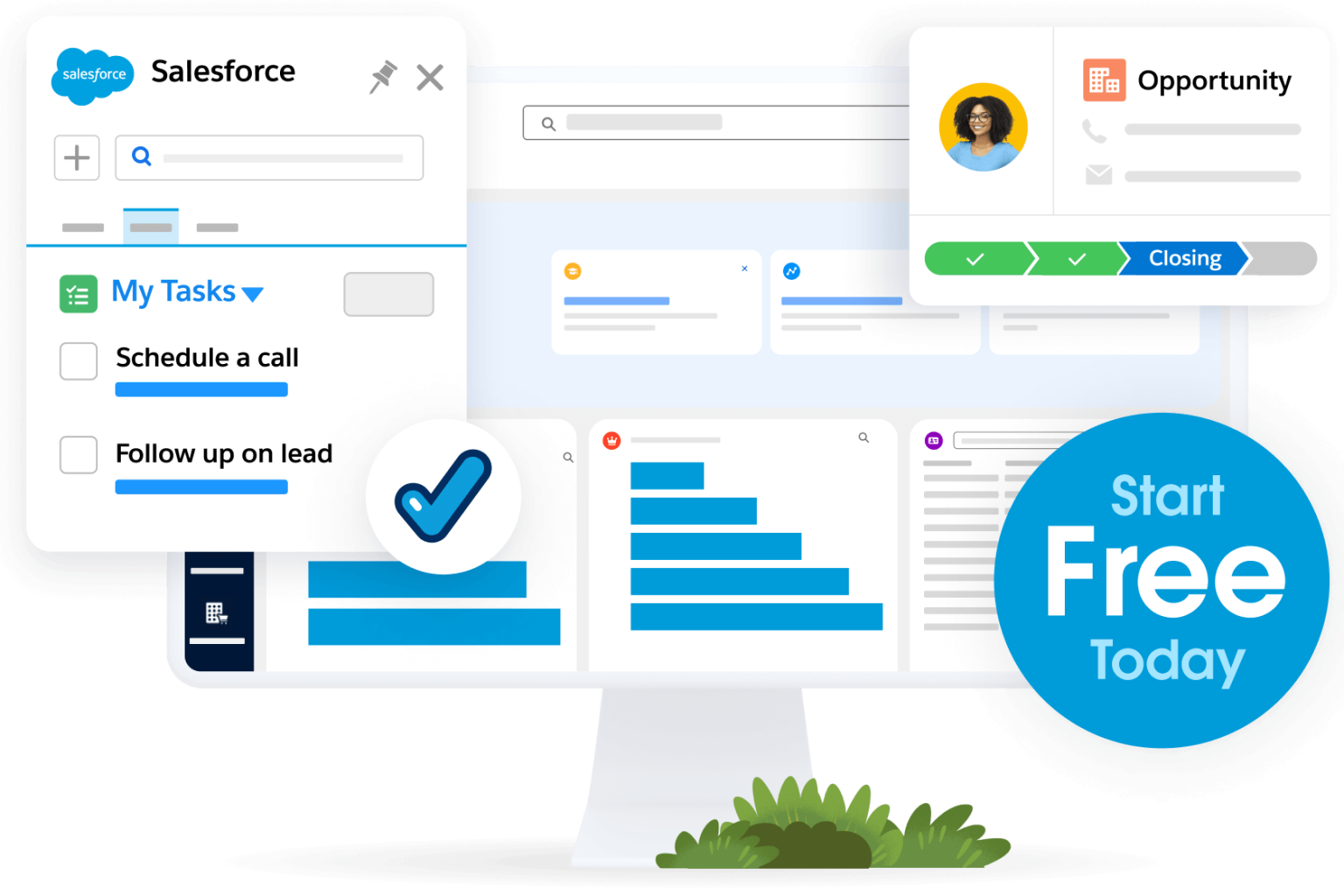
Centralize business with the right platform
The tools are here. The integrations are ready. The only thing standing between you and a central business platform that works is getting started. Salesforce gives you the connected foundation you need — without the complexity you don’t.
Get started with Salesforce Suites for free or activate Foundations to try out Agentforce today.
AI supported the writers and editors who created this article.
What is a central business platform?
A central business platform is a connected system — usually built around a CRM — that brings your sales, marketing, service, commerce, and productivity tools together in one place. Instead of managing separate apps that don’t share data, everything runs through a single hub so your team always has the full picture of your customer.
What integrations should a small business prioritize first?
Start with the integrations that eliminate the most manual work: email and calendar sync, a team collaboration tool like Slack, and accounting software. These three categories cover the core of how most lean teams spend their time, and connecting them to your CRM immediately reduces data entry, missed follow-ups, and context-switching.
Does Salesforce Starter Suite include integrations out of the box?
Yes. Starter Suite includes built-in integrations for email, calendar sync, and Slack, so your team is working from a connected platform from day one — no technical setup required. Growing teams can access even more integrations through AgentExchange when they upgrade to Pro Suite.
How does AI work within a connected central business platform?
AI needs data to be useful — and a connected central business platform gives it exactly that. When your CRM has a complete view of every customer, AI can surface the right next action, automate routine follow-ups, and personalize outreach at scale. Learn more about how Agentforce works for small businesses.
Can a small business build a central business platform without an IT team?
Absolutely. Salesforce is designed specifically for teams without dedicated IT resources — it includes guided onboarding, pre-built dashboards, and turnkey AI so you can get value from day one. As your needs grow, Salesforce data integration resources for small businesses can help you plan your next steps.