Do AI Experiences Enable Human Strengths to Shine?
Trailblazers want to bring more of their creativity, expertise, and judgment to human-AI interactions. Here are five questions to guide designers.


Key Takeaways
People bring their own ideas to AI, give it context it can’t infer, and check answers they remain responsible for. How could the experiences we design make those contributions easier?
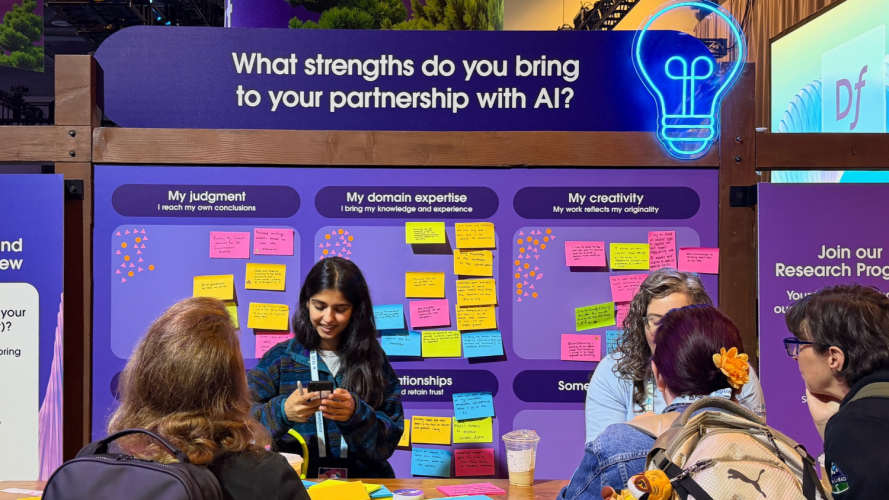
At Dreamforce, the Salesforce Research & Insights team asked 2,714 Trailblazers which human strengths they already bring to their work with AI, which they want to bring more of, and how they apply them. The research wall activity we hosted was one wide-angle look at this question. It sits alongside a deeper research partnership with the Salesforce Office of Ethical and Humane Use on how experts encode their judgment to get higher-quality outcomes with AI.
The responses, from a self-selected group of conference participants, inspired five questions designers might consider when they build AI experiences.
Here’s what we’ll cover:
Who gets to offer the first idea: the person or AI?
Does the experience build on people’s expertise, or make them explain it all over again?
Is it as easy to check and challenge an AI answer as it is to accept it?
Is verification built into the work, or left for people to remember?
How could the experience help people build trust with others?
Bring these questions into your next design review
Who gets to offer the first idea: the person or AI?
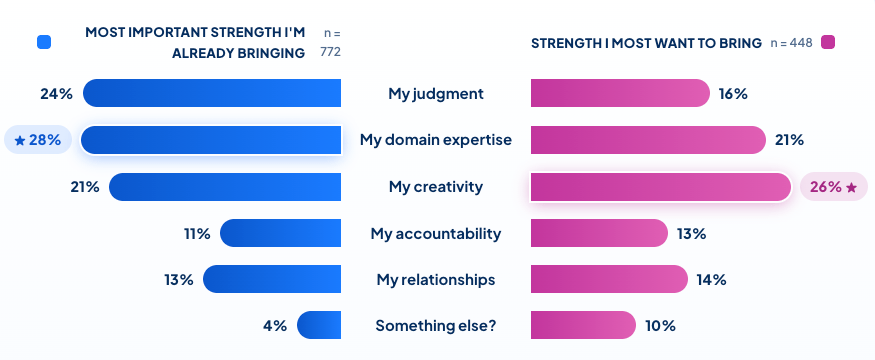
Creativity showed the widest gap between the strengths people said they already bring and those they want to bring. It received the most “want to bring” votes. One Trailblazer wrote, “I rely on ideas from AI too heavily. I’d like to strengthen that skill.”
For us, that gap suggests a concern beneath the excitement about AI. In a world of instant drafts and confident answers, people may want more room to exercise their own creativity.
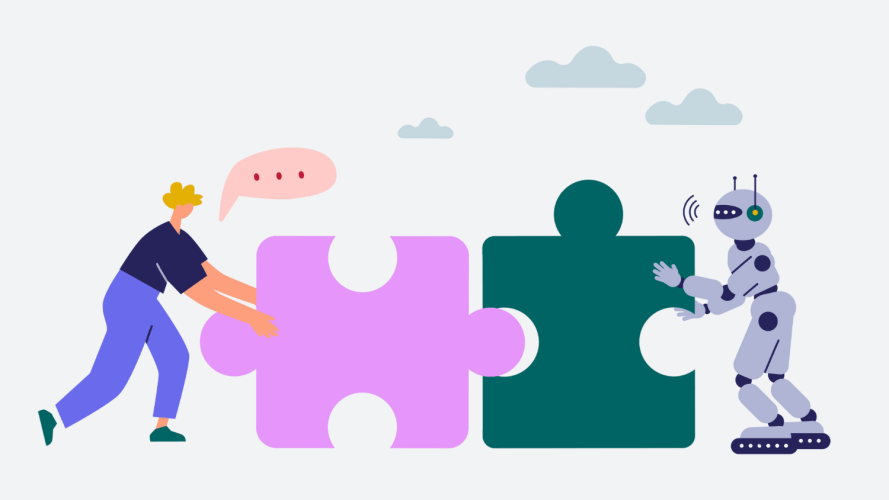
Trailblazers also described ways they protect that room. A recurring approach was simple: human goes first. “I draw a sketch first, then take it to AI,” one wrote. Another explained, “I come up with the creative idea, then ask AI about any challenges with it, and to expand on it to bring it further to life.”
In these examples, people bring an idea before asking AI to pressure-test or extend it. Others described using prompting itself as a creative medium: questioning the norm, reframing a problem, and iterating. They also revised generated content and rejected suggestions that didn’t sound like them.
These practices raise a design question about where the thinking begins. Could an experience invite a person’s sketch, draft, or point of view before offering a suggestion? Giving people that option could help them protect the creativity they want to bring, while still using AI to develop it.

Does the experience build on people’s expertise, or make them explain it all over again?
Domain expertise received the most “already bringing” votes at our wall. Participants also wanted to apply it more. It was a strength they recognized as central to their work with AI.
That expertise includes hard-won knowledge of the business, industry, and their Salesforce org. It also includes a read on organizational politics and culture: what will work, what might stall, and why. People described giving AI context it couldn’t infer and telling it which sources to trust.
Their contributions extended across business and technology. They translated requirements into technical solutions, connected knowledge across systems, and used what they knew to spot mistakes or nuances in AI’s output. Expertise also helped them decide where AI fit and when not to use it.
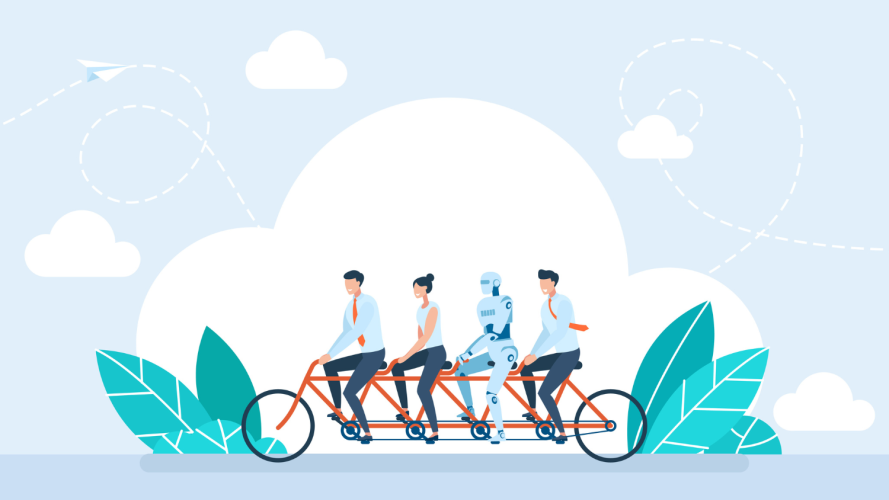
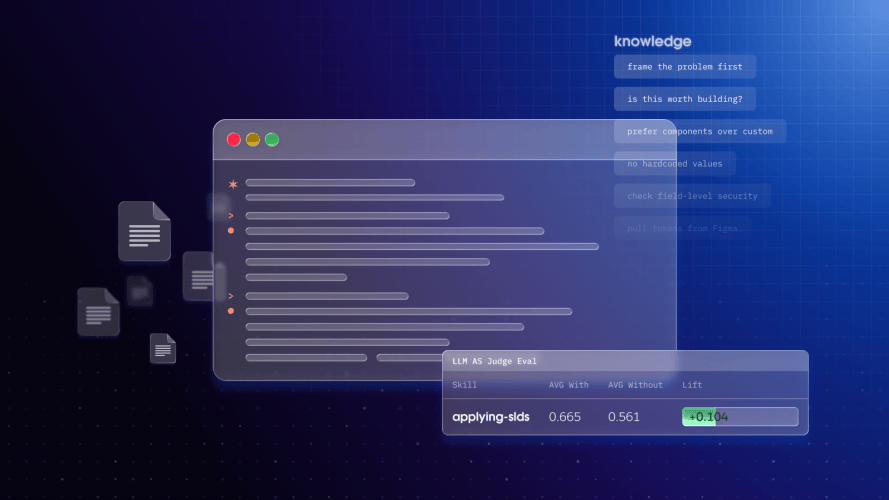
For designers, the question is how to let that knowledge into the experience and keep it available. Can people supply relevant background and correct an assumption? Can the expertise they contribute support later work, rather than having it be reconstructed in every prompt? Skills, agents, and workflow templates are possible ways to carry expertise forward; the design consideration is making context easy to give and easy to keep.
Is it as easy to check and challenge an AI answer as it is to accept it?
Judgment was the second-most selected strength people said they already bring. Their comments were less about having good instincts and more about deliberately testing AI’s work.
“Pressure test outputs based on real-life scenarios,” one Trailblazer wrote. Another asked, “Don’t just tell me. Show me your sources of how you got there.” Participants described checking answers against domain knowledge, comparing responses across models, and questioning the original request before prompting.
These are ways of deciding whether an answer holds up and whether it addresses the right problem. Some also asked AI to validate its own output. That can be part of the process, but it doesn’t replace checking against reliable sources and real-world knowledge.
The design opportunity is to treat people’s checking habits as something the experience can support. Can they inspect sources, test an answer against a relevant scenario, and challenge an assumption? Can they repeat those checks as the work develops? The question is whether scrutiny has a place in the workflow, rather than depending entirely on a personal routine.
Is verification built into the work, or left for people to remember?
Accountability received the fewest votes among the named strengths, both for “already bringing” and “want to bring.” Yet the most-starred note on the wall was about accountability. It observed that AI has “no skin in the game.”
Our read is that people may notice the expertise and judgment they bring up front more than the checking they do at the end. That final checking can be where they decide whether the work is ready to use. As one Trailblazer put it, “At the end of the day, I still own it and have to attest to it.”
Participants described reviewing drafts before external use, rerunning numbers, testing repeatedly, and escalating to a human subject matter expert when unsure. Verification gave them a basis for taking responsibility for the result.
For designers, this raises the question of whether review is a visible part of the work or something people have to remember afterward. Where can someone verify a consequential result before it’s shared or acted on? What happens if they find a problem or need expert help?
For an agent that takes action, responsibility also involves defining boundaries beforehand and reviewing behavior over time. The experience could support those steps by making limits, review points, and opportunities to intervene clear. The aim is to give people a way to exercise the accountability that remains theirs.
How could the experience help people build trust with others?
Relationships received fewer votes, but participants described them as important to building organizational trust in the AI systems they implement. They also wanted to use AI to deepen those relationships.
Trailblazers described starting with small proofs of concept so hesitant coworkers could see value, then protecting that trust through careful data stewardship. They involved multiple stakeholders and gathered feedback before prompting, to confirm they were solving the right problem. They also revised generated content to sound human and resonate with its intended audience.
These practices connect trust in a system with the relationships around it. For designers, they raise questions about how an experience could support stakeholder input, thoughtful communication, and opportunities for people to respond to the work. AI can assist, while people continue to listen, understand concerns, and earn trust.
Some of the strengths people shared didn’t fit neatly into the categories on our wall: empathy, values, and lived experience. One of our favorite notes captured that with a wonderfully specific example: “I bring my life experiences that no AI has, like paper cuts!”
That comment is a reminder that the contribution a person makes can extend beyond the expertise a task calls for. Their experiences and values also shape what they notice, question, and care about.
Bring these questions to your next design review
People at our research wall described ways they already bring their strengths to AI-assisted work. Use these five questions to consider how your design could support those practices: making room for an idea, retaining expertise, enabling repeatable checks, making verification visible, and involving others. Look for one moment where doing so could reduce the extra work a person has to remember.
We found a hopeful thread in these reflections: people want to bring their whole selves to their work with AI, and they’re finding ways to do it. That leaves a question for us as designers and as people using these tools: What’s the human strength you most want to bring, and how could the experience make room for it to shine?