

Every business has a story worth telling. The challenge for lean businesses isn’t having something to say — it’s making sure the right people hear it, at the right moment, in a way that actually earns their attention.
A great newsletter does exactly that. When it’s done well, it’s not just another email in a crowded inbox — it’s a direct line to your most important relationships, a consistent way to build trust, and one of the highest-return tools in your marketing stack. No big team required.
We’ll share how to create a newsletter that people genuinely want to open — from nailing your first impression to building a content rhythm that keeps subscribers coming back. Because when your message lands right, a simple email becomes one of the most powerful ways to grow.
Top 7 tips to craft a newsletter (with or without AI)
Here are a few steps to visualize, craft, and connect your newsletter to the right audience, and the tools you’ll need to get the job done. Let’s dig in.
1. Choose your newsletter goals
Before you draft a single word, you need to decide what success looks like for your newsletter. Are you trying to share weekly tips with prospects — or looking to announce new product arrivals to your customers? When you understand your why, the newsletter creation process becomes much more focused for you and your team.
Here are some ways to define your goals for any time of newsletter:
- Focus on education: Share “how to” guides or industry news that positions your startup as an expert in the field.
- Focus on value: Highlight how you can solve problems, or ways you can help to encourage browsing on your site.
- Focus on community: Use stories about your team or customer spotlights to build a deeper emotional bond.
2. Build a clean and mobile-friendly newsletter layout
Most people will view your message on a smartphone while they’re waiting in line or taking a quick break. This means your design must be simple, with plenty of space between paragraphs, so it’s easy to skim on a small screen.
If your layout is too cluttered, readers will likely hit delete before they even get to your best offer. A great way to start is by looking at newsletter templates that prioritize a single-column design for better readability. And remember, design for the thumb:
- Use large buttons: Make sure your links are easy to tap without accidentally hitting something else.
- Keep text short: Aim for brief sentences and bullet points to keep the reader moving down the page.
- Check your images: High-quality visuals are great, but make sure they don’t slow down the loading time of your email.
3. Write subject lines that earn the click (and content that converts)
Your subject line is the most important part of the entire message because it’s the only thing standing between an open and the trash bin. Avoid being too vague or using “salesy” language that triggers spam filters. Instead, try to create a sense of curiosity, or offer a clear benefit, that makes the reader click. Learning how to create a newsletter that stands out starts with mastering these first few words that appear in the inbox. Here’s how to craft the perfect hook:
- Be specific: Use numbers or names to make the topic feel more tangible and urgent.
- Personalize the text: Including the recipient’s name can make the message feel like a one-on-one conversation.
- Test your ideas: Try two different versions of a subject line to see which one your audience prefers.
Pro tip: Use artificial intelligence (AI) tools to help draft creative subject lines and an AI customer relationship management (CRM) to automate these newsletters out to your entire email list.
Learn how AI-driven CRMs are
changing the face of small business.


4. Gather and organize your subscriber list
You can’t have a successful campaign without a healthy list of people who actually want to hear from you. Never buy a list of names, as this can hurt your reputation and lead to your emails being blocked by major providers. Instead, place a simple sign-up form on your website and offer a small “thank you” — like a discount code or a free guide — for joining your community.
As you learn how to create your newsletter, you’ll see that a small list of engaged fans is much better than a large list of strangers. Here are some ways to grow your audience organically:
- Use social media: Share a preview of your latest issue on your social channels to encourage new sign-ups.
- In-person sign-ups: If you have a physical shop — ask customers if they want to join your list at the checkout counter.
- Clear opt-ins: Always make sure people know exactly what they’re signing up for and how often they’ll hear from you.
5. Use what works (your data) to improve your results
Once you send your first few messages, it’s time to look at the numbers to see what’s working. Pay attention to your open rates and click-through rates (CTR) to see which topics get the most attention. If you notice that a certain type of content always gets clicks, do more of that in the future.
This feedback loop is a vital part of a newsletter that stays relevant as your business grows and your audience changes. Here are some metrics to consider:
- Open rate: This tells you if your subject lines are doing their job and catching people’s eyes.
- Click rate: This shows if your content is interesting enough to make people want to learn more on your website.
- Unsubscribe rate: A high number here might mean you’re sending emails too often — or the content isn’t what they expected.
6. Maximize outreach with smart automation
Running a startup means you’re likely wearing many hats and might not have hours to spend on marketing every week. This is where modern software can help by handling the repetitive tasks for you. You can set up “welcome” emails that send automatically when someone joins your list — or schedule your monthly updates in advance.
Using AI can also help you brainstorm ideas for your next issue or even suggest the best time of day to send your message.
- Personalization at scale: Use customer data to send messages that feel tailored to each person.
- Better timing: Some tools can predict when a specific customer is most likely to check their inbox.
- Content suggestions: Get help writing headlines or summarizing long articles into quick – hitting snippets.
7. Maximize engagement with AI
As your business matures, you may want to look into more advanced ways to interact with your fans. Using a unified platform, like a CRM tool, for your sales, marketing, and service needs ensures that you never lose track of a customer’s preferences.
And, with an AI CRM, you can use digital assistants to help answer questions that come in after a newsletter goes out. This ensures that every click leads to a helpful interaction — rather than a dead end for your customer.
- Connect your data: Keep all your customer info in one place so your marketing is always accurate.
- Scale your support: Use bots to handle common inquiries so your team can focus on bigger projects.
- Improve the journey: See exactly how a newsletter lead turns into a happy, long – term customer.
Get Salesforce free for 30 days.
No credit card required, no software to install.

Examples of Salesforce newsletters that we love
At Salesforce, we love our customers. We provide specific newsletters for different industries, areas of business, and even AI. Here are some examples:
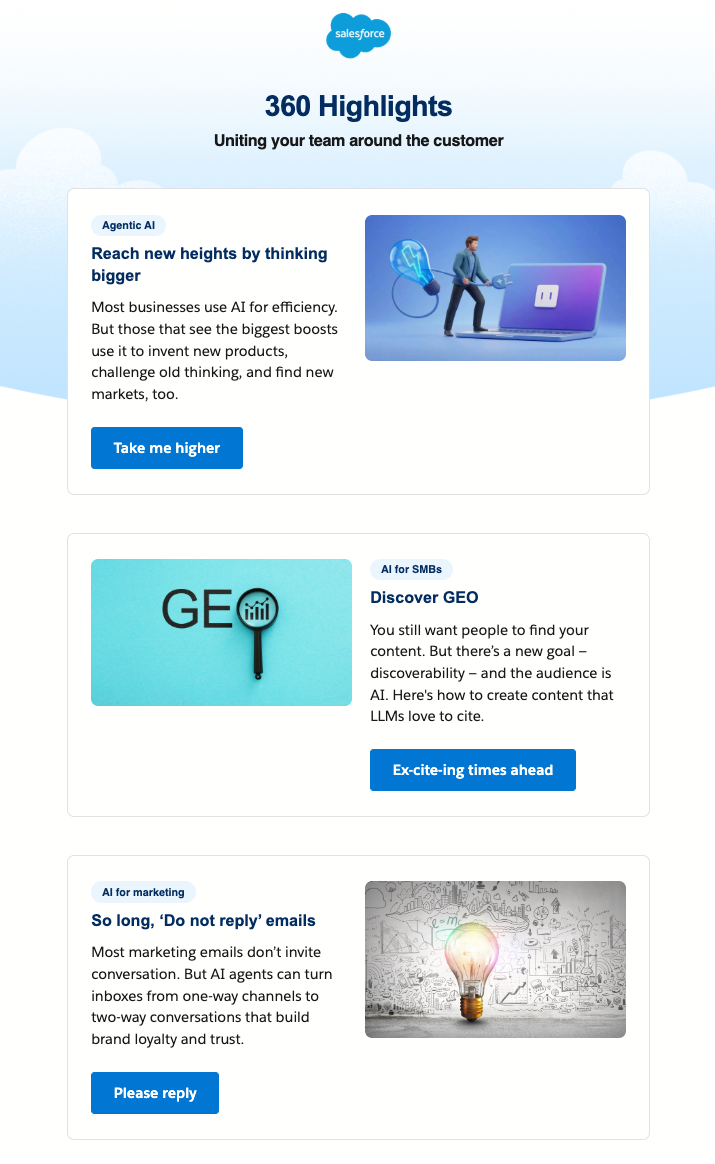
- 360: Unites your team around the customer with content covering AI agents, CRM strategies, and product innovation.
- MomentMarketer: Delivers resources to help you create unforgettable customer experiences using data and AI.
- Salesblazer: Provides news and insights specifically for sales professionals and sales success.
- Commerce Crew: Focuses on news, reports, and information relevant to commerce and ecommerce professionals.
- Serviceblazer: Offers content, free guides, and resources for customer service professionals.
Craft (and promote) the perfect newsletter for your business
You now have a complete seven-step roadmap to create a newsletter that stands out in the inbox and drives results. By focusing on simple design, valuable content, and smart automation, you can turn your email outreach into a powerful engine for growth.
Get started with Salesforce for free or activate Foundations to try out Agentforce today.
AI supported the writers and editors who created this article.
How often should a small business send a newsletter?
Most small businesses find success sending a message once or twice a month to stay relevant without overwhelming the inbox. The key is consistency — so choose a schedule that your team can realistically maintain over the long term.
What’s the best time of day to send a marketing email?
Mid-morning on Tuesdays and Thursdays typically sees the highest engagement for most industries. However, every audience is different — so it’s smart to test various times to see when your specific customers are most active.
How do I keep my emails from going to the spam folder?
Always get permission before adding someone to your list and avoid using excessive capital letters or “trigger” words in your subject lines. Providing a clear and easy way to unsubscribe is also a legal requirement that helps maintain your sender reputation.
Can I use AI to help write my newsletter content?
Yes – many small businesses use smart tools to generate subject line ideas, draft short summaries, or even suggest images that match the text. This helps smaller teams produce professional – quality content in a fraction of the time.
What should I do if my click rates are very low?
Try making your call to action (CTA) more prominent by using a brightly colored button instead of a plain-text link. You should also ensure that the content you are linking to is directly related to the promise you made in the subject line.