


What Are Intelligent Agents?
Learn what intelligent agents are, what they need to be effective, how they can benefit organisations, and how you can put them to work in yours.


Learn what intelligent agents are, what they need to be effective, how they can benefit organisations, and how you can put them to work in yours.
Intelligent agents are AI-powered systems that interact with their environment to analyse data and make decisions based on specific goals.
Imagine a personal assistant who anticipates your needs, effortlessly adapting to new tasks — except this assistant isn't human. Intelligent agents are shaping the future of automation by simplifying processes from customer support to financial forecasting. Unlike traditional software, which follows rigid rules, these agents can learn from experience and operate independently.
Australian teams are already putting these capabilities to work. More than three in four ANZ knowledge workers have engaged with intelligent agents in some form, and 37% are already delegating tasks for them to handle independently.
Adoption isn’t limited to frontline employees, either. In finance, AI agents detect fraudulent transactions before they go through. In healthcare, they help monitor patients and recommend treatments. Intelligent agents can process vast amounts of data and react accordingly, making them indispensable tools.
Think of intelligent agents as the ultimate problem solvers. They analyse information, make decisions, and adapt their approach over time. But how do they actually function?
There are three main stages at which intelligent agents operate:
The real magic happens when these agents learn and adapt. Instead of following static instructions, they continue to adjust their strategies based on past interactions. This ability to evolve makes them invaluable for improving routine workflows within your company.
Traditional automation follows predefined rules and workflows, so its steps are mapped out in advance. By contrast, intelligent agents can interpret new requests on the fly and adapt as information changes, using context to decide on the next best action. Here’s how the two approaches compare.
| Area | Traditional automation | Advanced intelligent agents |
|---|---|---|
| Decision-making | Follows predefined rules set in advance | Can make decisions in the moment based on the goal and context |
| Handling changing situations | Follows a predefined path for each situation it has been designed to handle | Can adjust its approach as new information becomes available |
| Taking action | Runs a set workflow when a specific event or condition triggers it | Chooses which tools or automations to run based on context, then uses the results to guide the next step |
| Tasks it’s suited for | Repeatable tasks that have clear steps, like sending a payment reminder | Tasks that require interpreting a request and working out the steps needed to resolve it |
Traditional automation is ideal for predictable, repeatable tasks, like sending payment reminders after a two-day threshold. However, it's limited by the paths it's been programmed to follow.
Intelligent agents take things further. They can work in live environments, respond to real-time requests, and use real-time customer context to decide on the next step and take action across connected business systems.
For example, Agentforce, our AI agent platform, can carry work across departments and draw on shared customer data to understand customers, recommend actions, and complete multi-step workflows across the entire customer journey. For instance:
This kind of automation changes the game, both in the way businesses serve customers and how they keep work moving across teams. It can also free up budget to invest elsewhere. According to our State of Agentic AI in the Enterprise report, organisations with fully deployed AI agents reported a 29% average reduction in operating costs.
There are a few things that set intelligent agents apart from other AI-driven tools. Autonomy and adaptability are just two of the main characteristics that define agents.
Your AI-powered tools should get smarter over time, which is why intelligent agents use past interactions to improve future decisions. For example, an AI-powered recommendation engine can analyse what customers have clicked on to narrow down future product suggestions.
Intelligent agents are particularly good at processing large amounts of data instantly. Those quick processing times allow for responses that are just as prompt. Many financial institutions use agents to detect fraud the moment suspicious transactions occur since there is very little delay between the event and their response.
Intelligent agents don't just act — first, they evaluate. As they analyse the outcomes of past decisions, intelligent agents can fine-tune their algorithms for better accuracy. This feedback loop leads to continuous improvement, no matter what tasks the agent is designed to do.
Context is key for decision-making, so intelligent agents store and recall past interactions to make smarter choices. That's why virtual agents like chatbots remember previous conversations, allowing for more natural and personalised interactions.
Depending on their complexity and purpose, intelligent agents fall into several categories that are each suited for different tasks. Understanding these distinctions can help you determine which type best fits the needs of your business.
These agents operate on a straightforward principle: if a specific condition is met, they take a predefined action. They don't store past experiences or learn from previous interactions. You can picture this by thinking of a thermostat. When the temperature rises above a set threshold, it turns on the air conditioning. Simple reflex agents work well in predictable environments, but they may struggle with more complicated decisions.
These agents differ from simple reflex agents in that they keep an internal model of their environment. Model-based reflex agents consider both current conditions and historical data to make more informed decisions. A self-driving car, for example, doesn't just react to immediate obstacles — it also anticipates potential hazards based on past observations and road conditions.
These agents strategise before reacting. Instead of taking action based on fixed rules, they consider different possibilities and select the one that best achieves a specific objective. For example, an AI-powered logistics system might calculate multiple delivery routes before choosing the fastest or most cost-effective option.
When multiple outcomes are possible, utility-based agents weigh the pros and cons of each to determine the best course of action. Unlike goal-based agents, which simply aim to achieve an objective, utility-based agents also consider factors such as safety or customer satisfaction. A financial trading algorithm, for example, doesn't just aim for profit — it also assesses risk levels to make the most beneficial trades.
These agents take adaptability to the next level. They start with a baseline of prior knowledge, learn from experience, and improve their performance over time. Machine learning models, such as fraud detection systems, fall into this category. The more data they analyse, the better they become at identifying fraudulent transactions.
Intelligent agents are already changing the way businesses work. They help automate tasks and improve efficiency. No matter your industry, these agents can streamline processes and boost productivity.
Intelligent agents help banks and financial institutions detect fraud, score credit applications, and predict market trends. For example, they monitor transactions in real time and flag unusual activity before fraud happens.
This is a use case that goes down well with customers, too. In our Connected Financial Services Report , preventing and detecting fraud was the AI use case consumers were most interested in, with 77% expressing interest.
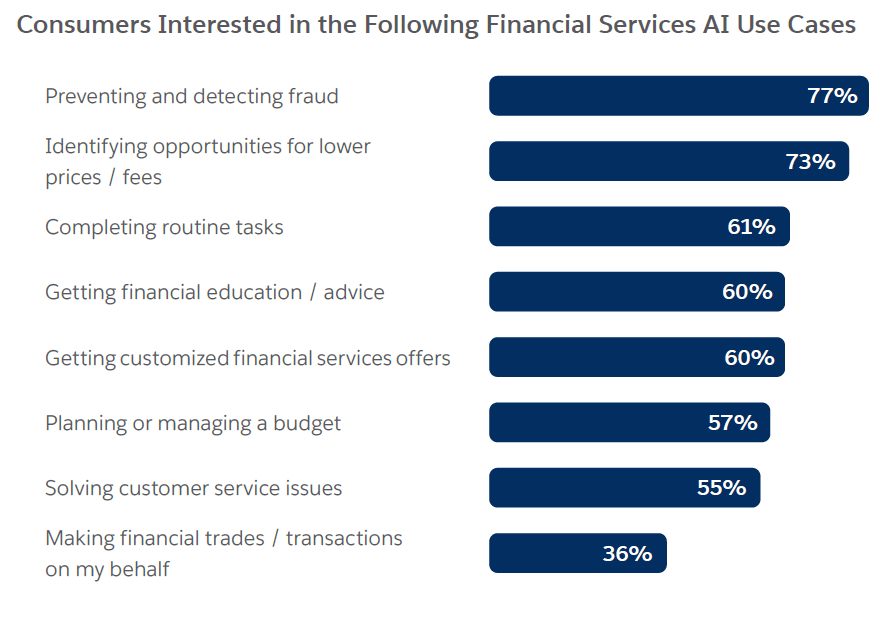
Source: Salesforce, Connected Financial Services Report
Factories can use intelligent agents to keep operations running smoothly. These agents track supply chains and predict when machines need repairs, all of which helps improve production speed. By spotting issues early, they help reduce downtime and save money.
AI agents are making customer service faster and more efficient. Today, 66% of service organisations are using AI agents in some form. AI agents can answer questions, suggest products, and route more complex issues to service reps. This means faster responses, happier customers, and lower support costs.
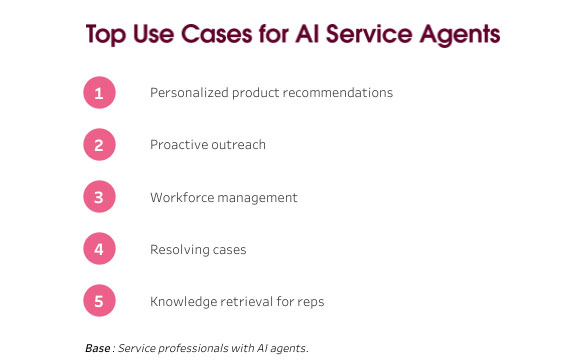
Source: Salesforce, State of Service: AI Agents Edition
Intelligent agents help doctors and hospitals manage patient care. They track symptoms and predict health risks based on patient data. Some hospitals also use AI to schedule staff and manage resources more effectively.
AI agents are also helping healthcare providers offer support beyond office hours. That can make a significant difference, as 67% of patients say they would rather get help anytime, even through AI, than wait to speak to someone during office hours.
Perhaps the main reason to adopt intelligent agents is how they help you work faster and reduce costs. Whether automating tasks or analysing data, they bring real value to your daily operations.
AI agents can handle repetitive, time-consuming tasks (such as data entry), freeing up your software development teams for more valuable work. Instead of manually sorting emails or scheduling appointments, employees can focus on solving problems and building customer relationships.
The key here is embedding AI where work happens: 94% of surveyed leaders agree that embedding AI into core workflows delivers more value than using it as a separate tool.
By automating mundane tasks and processes, intelligent agents cut down on labour costs and prevent errors. In customer service, for example, AI chatbots often handle common enquiries, reducing the need for large support teams. In manufacturing, predictive maintenance can help prevent unexpected equipment failures — which saves both money and time.
Data analysis from intelligent agents helps you make smarter decisions about things like delivery routes or inventory levels. They detect fraud before it happens, predict customer trends, and improve supply chain efficiency. The accurate insights you gain from AI agents can help you make faster, more data-driven decisions that improve customer satisfaction.
AI-powered chatbots and virtual assistants make customer interactions faster and more personalised. Instead of waiting on hold, customers get instant answers. Intelligent agents can also suggest relevant products and provide 24/7 support, which leads to happier customers and stronger brand loyalty.
In our 2026 State of Agentic AI in the Enterprise report, organisations with fully deployed AI agents reported an average 29% improvement in customer satisfaction (CSAT).
Unlike human teams, intelligent agents can handle thousands of requests at once — all without losing speed or accuracy. That includes responding to customer requests, analysing market data, and managing supply chains. Your business can grow without needing to hire and train large teams, making AI a cost-effective way to expand operations.
Intelligent agents bring a variety of benefits to the table, but they also come with challenges. Knowing how to manage these risks can help you get the most out of your AI assistants while avoiding potential pitfalls.
Intelligent agents rely on data, including sensitive customer information. If this data isn’t properly secured, it can be vulnerable to breaches or misuse. To protect data privacy, you need to follow the laws that apply to your business, including Australia’s Privacy Act 1988 .
Meeting these obligations starts with deciding what information agents can access and how they can use it. Practical safeguards include encrypting data, limiting access to authorised users, maintaining strong cybersecurity measures, and running regular audits.
You should also check how AI providers retain and use customer data, including whether they use it for model training.
AI decisions can be fair and unbiased, but that's not always the case. If agents are trained on biased data, they can unintentionally discriminate against certain groups. To prevent this, you need to use diverse training data and set clear ethical guidelines. Be sure to test AI decisions regularly and make adjustments to ensure they remain fair and accurate.
Intelligent agents aren't a plug-and-play solution. They require specialised knowledge and resources to develop and integrate with your systems, including customer support or marketing. Businesses without AI expertise may struggle to implement intelligent agents, so you should partner with AI experts and use pre-built AI solutions. These strategies, along with employee training, can help make adoption easier and more effective.
Intelligent agents need current, accurate data to make useful decisions and complete tasks. As per our State of Agentic AI in the Enterprise report, 63% of organisations that have deployed AI agents have experienced an agent acting on stale, missing, or wrong data, or failing to complete a requested action in a customer-facing workflow.
Start with the data your chosen use case needs. Connect the relevant systems through reliable APIs or integrations, and test whether the agent can retrieve up-to-date information and complete the intended actions.
AI agents can transform your business, just as they’ve transformed many industries. If you're looking to automate customer support or optimise logistics workflows, intelligent agents can help. The key is finding the solution that fits your needs.
Agentforce can help you build AI agents, ground them in your trusted business data, and deploy them at scale. Here’s what that can look like in your business:
Ready to put intelligent agents to work? Explore some of our favourite use cases for inspiration, or watch the Agentforce demo today to see how AI agents turn customer context into action across sales, service, marketing, and more.


Take a closer look at how agent building works in our library.
Launch Agentforce with speed, confidence, and ROI you can measure.
Tell us about your business needs and we’ll help you to find answers.
An artificial intelligence agent (or AI agent) is a system that uses AI to interpret context, make decisions, and autonomously take action towards a goal. Depending on their design, artificial intelligence agents can:
Salesforce’s Agentforce connects AI agents to business data and tools so they can answer customer questions and carry work through to completion.
No. A large language model (LLM) can power an intelligent agent, but it isn’t a complete agent on its own. An LLM agent combines a language model with additional capabilities that help it complete tasks, such as:
AI agent platforms like Salesforce’s Agentforce bring these capabilities together so agents can move beyond generating answers to carrying out work. For example, an agent could interpret an appointment request, then check availability and complete a booking, all autonomously.
An AI agent can choose and carry out actions towards a goal, while a basic chatbot mainly responds to questions. The main distinction is what the system can do beyond the conversation:
For instance, while a chatbot could explain a returns policy, an AI agent solution like Agentforce could check the customer’s order, arrange an eligible return, and update their customer record in the same sequence. It’s night and day.
Not necessarily. The cost of intelligent agents depends on the work they do, the systems they connect to, and how widely they’re used. When estimating a budget, consider:
Some platforms also include artificial intelligence and intelligence agents at no extra cost. For example, Salesforce’s Agentforce is now embedded directly into its Free CRM, Starter Suite, and Pro Suite offerings, helping businesses summarise customer records and draft personalised follow-ups without paying for a separate AI tool.


