



Meet Sarah Crumb, the (totally fictitious) owner of a local bakery called “The Daily Crumb.” For months, Sarah was sending one weekly email to her entire list, promoting every pastry she baked. Her open rates were low, and sales barely budged. Then, Sarah decided to stop guessing and start using her data.
She realized her point-of-sale system tracked everything: who bought what, and when. By connecting this data to her customer relationship management (CRM) platform, she was able to use the data to personalize the marketing experience..
Now, customers who typically buy sourdough get an email about the new artisan loaves. Customers who buy coffee get a morning discount text on seasonal roasts. The result? Her open rates jumped 30%, and her targeted pastry sales doubled. Sarah didn’t have to hire a new marketing team; she just used the right data she already had with the right tools.
That is the power of becoming a data-driven small business. It’s not about complex algorithms; it’s about making your marketing simpler, more personal, and most importantly, more effective, by listening to what your customers are already telling you. Let’s talk about what it means to have a data-driven marketing strategy.
The foundation of data-driven marketing: Your CRM
Small businesses often start with disparate tools: a spreadsheet for leads, an email marketing platform, and a separate system for service tickets. This fragmented approach makes it nearly impossible to get a full picture of the customer journey.
To execute a data-driven marketing strategy, the first step is centralizing your customer information. Think of your CRM system as the single source of truth for every interaction a customer or prospect has with your small business.
From the moment they click on an ad to their last service ticket, this marketing data is invaluable, but only if it’s unified and accessible.
Your CRM should connect the dots between all your customer-facing teams:
- Marketing data: This includes website traffic, email open and click-through rates, social media engagement, and campaign conversion rates. This data tells you what content resonates, and where your best customers are coming from.
- Sales data: Information on lead scoring, conversion velocity, deal size, and sales cycle length. This shows you the path from a qualified lead to a closed deal, helping you optimize your funnel.
- Service data: Details on support tickets, resolution times, common pain points, and customer satisfaction (CSAT) scores. This data highlights areas of friction and opportunities for improvement or targeted upsells.
And, of course if you’re an ecommerce business, like Sarah, you can use your commerce data to optimize the shopping experience. For example, a customer buys cupcakes often, and so Sarah’s CRM has tagged her for updates on new icing flavors and discounts for cupcake-themed holidays.
Using dynamic audience segmentation for direct contact
The foundation of strong personalization is audience segmentation. Instead of sending one message to your entire email list, you can use your CRM data to divide your audience into smaller, more specific groups based on shared characteristics.
While classic CRM segments might group users as “males, age 25–40,” a data-driven strategy focuses on intent and action. By integrating website interactions, email open rates, and past purchase data into the CRM, you can segment based on:
- Demographics: location, industry, or business size.
- Behavioral data: past purchases, products viewed on your website, or content downloaded.
- Engagement levels: Identifying “dormant” users versus “brand advocates.”
- Product interest: Grouping users who viewed a specific category three times in 48 hours.
- Customer journey stage: awareness, consideration, or loyal customer.
- Content consumption: Distinguishing between those who read technical whitepapers and those who watch short demo videos.
For example, the The Daily Crumb again — Sarah can see interested people locally by the community groups shes joins, by their likes and comments on her Instagram, and if they’ve clicked on her “Welcome to Your Daily Crumb” emails. This targeted approach dramatically increases the relevance of her marketing, which in turn boosts conversion rates. In fact, research shows that 67% of small businesses say data helps them prioritize customer experiences, confirming that personalization leads to better outcomes.
Personalize the marketing journey with AI
Personalizing every customer interaction manually can be overwhelming for a small marketing team. This is where artificial intelligence (AI) tools become essential. AI, particularly within platforms like Agentforce, analyzes vast amounts of customer data in real time and automates personalized decisions, effectively providing digital labor to your team. Here’s what you can look forward to:
- AI-powered product recommendations on your website or in follow-up emails. “If you liked that, you’ll love our new cheesecake!”
- Automated, personalized email subject lines that maximize open rates. “Here’s that new sourdough recipe we’ve been promising.”
- Personalized AI shopping agents that move the purchasing experience along and reduce cart abandonment. “Oops, looked like you left something in your cart.”
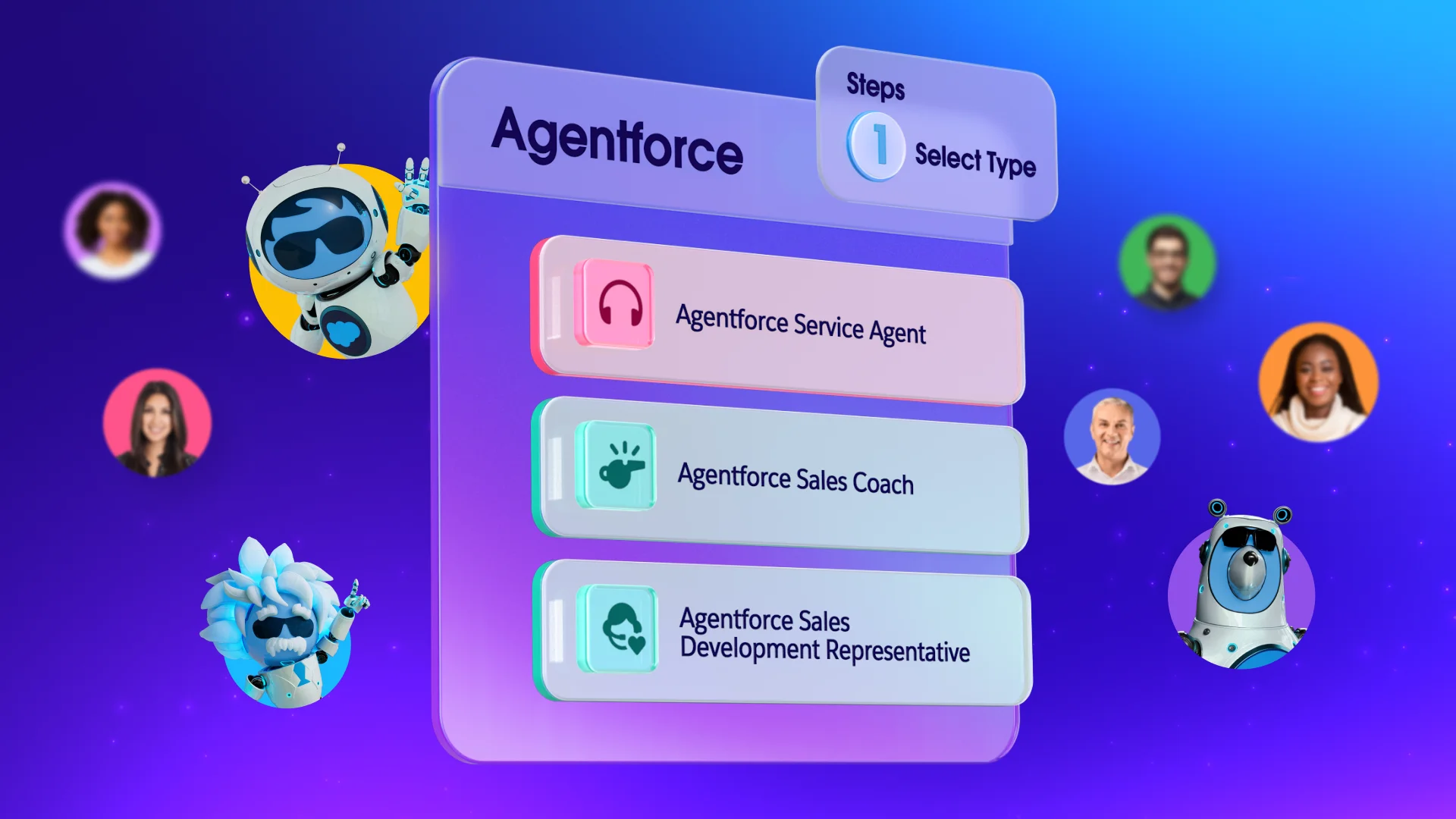
This allows your business to scale highly relevant interactions without adding headcount. For example, Sarah can try out an AI agent on her marketing journey with Agentforce 360. Her AI agent can automatically detect that a customer abandoned a shopping cart and trigger a timely reminder email containing the exact items left behind, increasing the likelihood of purchase completion. This smart use of data and AI ensures that your marketing efforts are always timely and impactful.
Measuring your data: Drive marketing performance
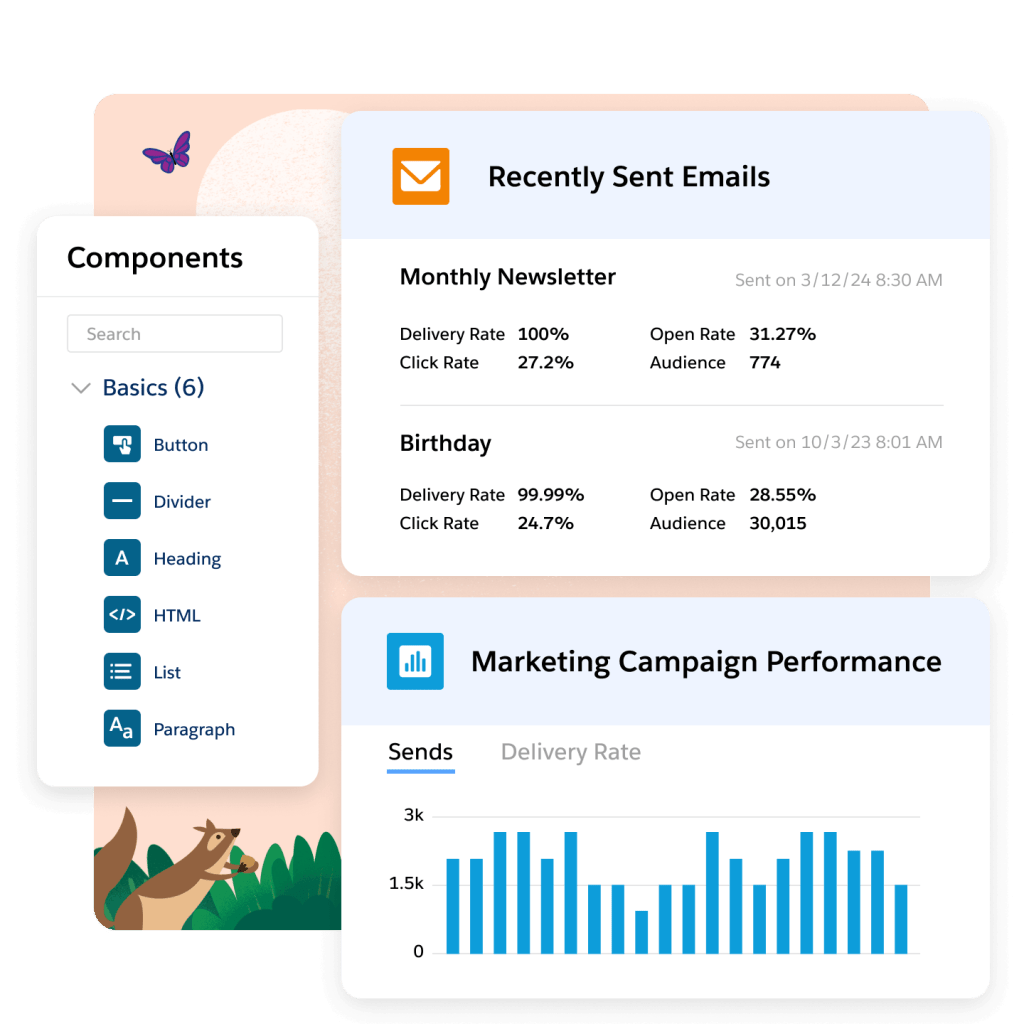
The final, and perhaps most important, piece of your data-driven marketing strategy is performance measurement. Without analyzing the results of your campaigns, you can’t truly be data-driven. For a growing business, this means consistently monitoring key performance indicators (KPIs) to understand what’s working, what’s not, and where to invest your next marketing dollars.
A marketing CRM acts as a bridge between high-level campaigns and individual sales, providing a level of detail that standard analytics tools can’t match. Because the CRM links data directly to a person’s contact record, it can track performance across the entire customer lifecycle. Here is how a marketing CRM tracks performance for you:
Lead source attribution: It automatically tags every new lead with its point of origin (Google Ads, LinkedIn, or a specific blog post) using UTM parameters and tracking pixels. This allows you to see which channels are actually driving the most qualified prospects.
Conversion rate tracking: The CRM monitors how many leads move through your funnel stages — from “subscriber” to “marketing qualified lead (MQL) to “closed won” — providing a clear picture of where your sales process is strongest or leaking.
Revenue-to-campaign mapping: By linking a closed deal back to the original marketing touchpoint, it calculates the exact revenue of specific campaigns. You can see, for example, that a $500 ad spend directly resulted in $5,000 of revenue.
Email engagement analytics: Beyond simple opens and clicks, the CRM tracks these actions at the individual level, allowing you to see which specific pieces of content resonate with which types of buyers.
Lead scoring accuracy: It evaluates the “warmth” of your leads by assigning points for behaviors (like downloading a whitepaper or visiting the pricing page). This helps you track whether your marketing is attracting high-intent buyers or just “window shoppers.”
Customer lifetime value (CLV): The CRM tracks long-term data like repeat purchases and upsells, helping you understand which marketing strategies are bringing in loyal, high-value customers rather than one-time buyers.
Sales cycle duration: It measures the time elapsed from the first marketing touch to the final sale, helping you identify which content or campaigns help shorten the sales cycle.
Ready to go Pro?
Level up your CRM with the top-rated Pro Suite — the customer platform that scales with you.
Small businesses can be data-driven too
Just like Sarah at The Daily Crumb, you can use valuable customer data to boost your marketing efforts, without breaking the bank. The shift to data-driven marketing is a journey of continuous improvement. For every campaign your small business runs — whether it’s an email blast, a social media ad, or a blog post — use those insights to refine the next one. And your CRM houses it all.
Start your journey with a free trail of Salesforce. Already a customer? Activate Foundations to try out Agentforce today.
AI supported the writers and editors who created this article.
What is data-driven marketing?
Data-driven marketing is a strategy that uses customer information and analytics — collected across sales, service, and marketing channels — to gain insights into customer behavior, optimize campaigns, and deliver personalized experiences that lead to more efficient and profitable growth.
Why is data-driven marketing important for small businesses?
For small businesses with limited budgets and resources, data-driven marketing is essential because it eliminates wasteful spending on guesswork. It provides clarity on which marketing efforts are generating the highest quality leads and sales, allowing the business to allocate resources effectively and compete against larger companies.
What is the first step a small business should take to become data-driven?
The first and most critical step is centralizing customer data. Small businesses should implement a unified customer relationship management (CRM) platform, like Salesforce, to aggregate data from all customer touchpoints (website visits, email engagement, purchase history, and service interactions) into a single, complete customer view. This unified data foundation makes analysis and personalization possible.
What kind of data should a small business be tracking for marketing?
Small businesses should track key metrics across three main areas: Acquisition (website traffic, cost per acquisition, lead conversion rate), engagement (email open rates, click-through rates, social media engagement), and value (customer lifetime value (CLV), return on investment (ROI), and churn rate). These metrics help gauge the profitability and effectiveness of marketing spend.
How does AI help small businesses with data-driven marketing?
AI tools help small businesses scale personalization and efficiency without needing a larger team. AI analyzes large datasets in real-time to automate personalized tasks, such as generating product recommendations, optimizing email send times, predicting customer churn risk, and streamlining segment creation, ensuring marketing efforts are always timely and relevant.