
How Canada Goose Used AI to Expand Capacity and Create a Revenue-Generating Experience Center



By augmenting its Style Experts with Agentforce, Canada Goose reduced peak-season wait times by 13.9% and improved customer satisfaction by 21.2%.

Every year during peak season, Canada Goose’s contact center fills with transactional service inquiries. Not intent-rich conversations about craftsmanship or fit or which jacket is right for which season, but questions about order status and warranty information.
Canada Goose’s contact center is designed around one core goal: delivering a premium, personalized experience that strengthens long-term customer relationships. This meant investing in a highly skilled, year-round team capable of delivering a premium customer experience at every interaction. As seasonal demand increased, the focus shifted from simply adding capacity to scaling intelligently while preserving service quality.
A significant portion of contact center volume consisted of the same high-frequency, low-complexity inquiries: “where is my order” (WISMO) and warranty status questions. The skilled team Canada Goose had assembled — trained to advise on product, build relationships and operate as style experts — was spending much of the company’s busiest season looking up answers to basic questions and relaying them back to customers.
By 2025, Canada Goose was ready to make a change. To help manage peak season, the company deployed Service Cloud Agent across digital and voice channels, handling routine interactions so human representatives could focus on high-value, experience-led conversations. Here’s how they did it.
A skilled team on the wrong calls
Each year during peak season, Canada Goose faced two perennial challenges. The first was structural. The company generates a significant portion of its annual revenue between October and January. Most retailers grapple with seasonal variability by staffing up with temporary workers during busy months. But Canada Goose wanted to ensure a white-glove experience for every interaction, and a contract worker onboarded in November can’t deliver the same level of service as a rep who’s spent the year learning the product. So the team stays full-time, year-round.
The second challenge was the nature of the surge volume. Order status and warranty-related questions represented a substantial share of total contact volume. These were thousands of information lookup requests coming in during the very window when staff had the least capacity to spare. Style Experts spent peak season fielding shipping queue questions and had no bandwidth left for the personalized exchanges that build loyalty and drive repeat purchase.
Built to support a team, not replace it
Canada Goose began by deploying Service Cloud Agent across SMS, WhatsApp and chat, targeting the four use cases that made up the bulk of routine volume: order status, warranty claim status, FAQ, and escalation routing. The agent went live at the end of October 2025, in time for the Thanksgiving surge. Within weeks, Canada Goose extended it to the phone channel, becoming one of the first customers globally to deploy Agentforce Voice.
Digital channels came first — a chance to prove the agent’s reliability across high-volume messaging interactions before moving to voice, where the margin for error is narrower. A stumble in a chat session is recoverable. Voice interactions require an even higher degree of accuracy and trust, making it important to validate the experience in messaging before expanding to voice. By the time the voice pilot launched in December, the team had six weeks of evidence that the agent could handle the core use cases correctly, at scale.
Agentforce is designed to accurately identify customer intent. Routine inquiries are resolved by the agent where appropriate. When human expertise is needed, Salesforce routes the interaction to a Style Expert through the appropriate sales or support queue based on the customer’s intent, with the full context of the conversation. This reflects Canada Goose’s operating model: one Experience Center team whose role has evolved to deliver both premium service and high-value, relationship-led customer engagement. The agent’s role is to remove friction, create capacity, and ensure human expertise is focused where it creates the greatest value.
On every transfer, the rep receives an AI-generated work summary before they pick up: the full conversation, the customer’s question, the agent’s response. The customer doesn’t repeat themselves. The rep arrives with all the relevant context.
How the system works
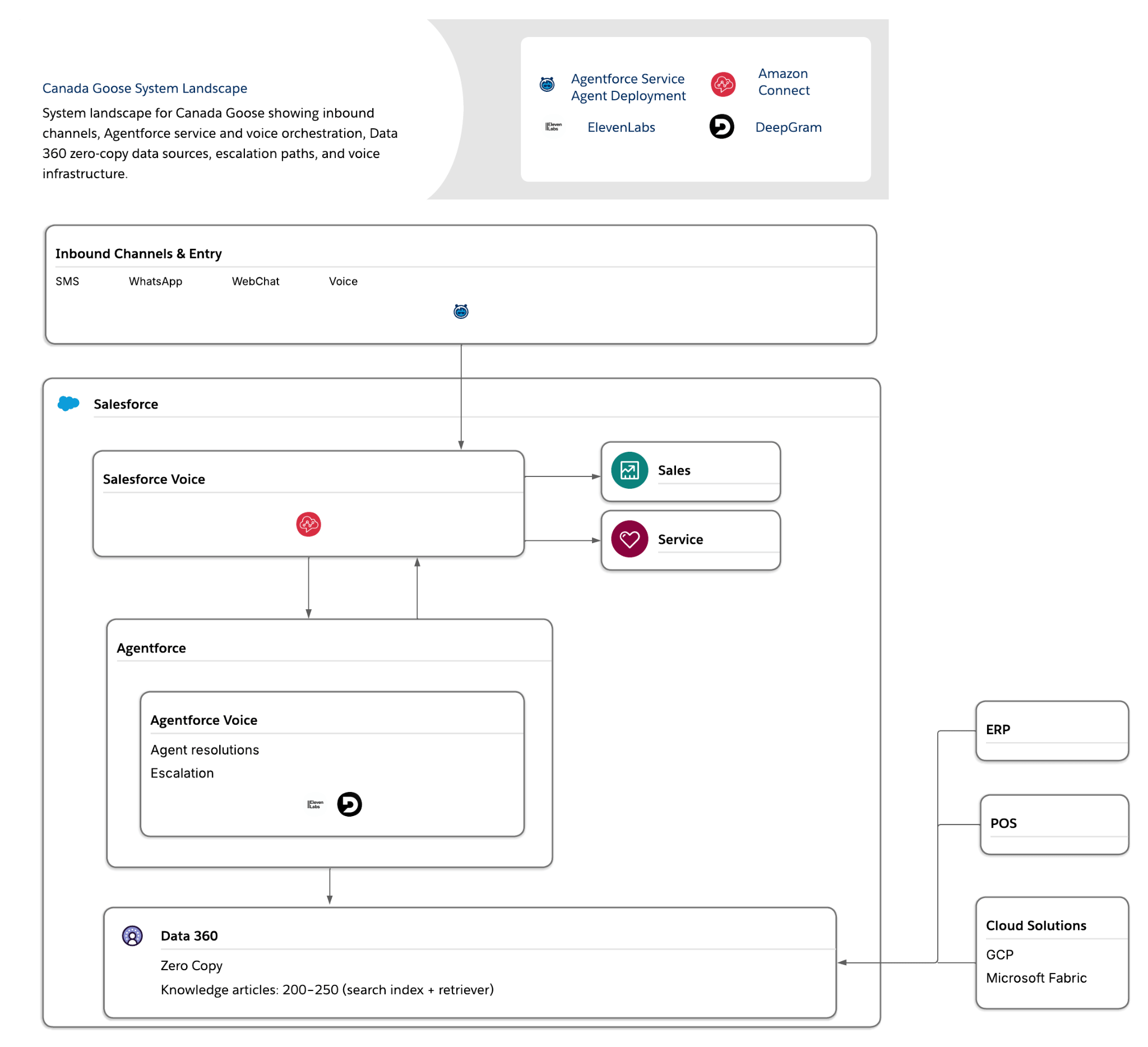
Service Cloud Agent is deployed across SMS, WhatsApp and chat. On the voice channel, inbound calls enter through Salesforce Voice with Amazon Connect which routes them to Agentforce Voice. For contained interactions, the agent resolves the call directly. For escalations, Salesforce routes the call to a Style Expert through either the sales or support escalation path, based on the customer’s intent, with relevant conversation context.
The voice channel uses ElevenLabs for text-to-speech and speech-to-text. A recent update enabled emotional tags, making the voice more natural and substantially reducing the agent’s tendency to talk over callers.
Grounding the agent required connecting it to Canada Goose’s full data landscape. Data 360 serves as the context layer, pulling order data from their order management system alongside ERP, POS, GCP, and Microsoft Fabric, without extracting or copying that data out of its secure environment. The hundreds of knowledge articles that anchor the agent’s FAQ and policy responses are organized through a search index and retriever setup.
Zero-copy architecture — Data 360’s ability to access personal customer data without moving it — played an important role in aligning with internal data governance and security standards. When the time came for legal and IT to sign-off, it was a key factor in enabling cross-functional alignment and confidence.
“Data 360 became a critical activation layer for us and what stood out most on the protection side was zero data copy. That was a differentiator for us. It played a significant role not just in my decision to move forward, but when I was stress-tested by legal and had conversations with the people responsible for managing data across the company, it gave them the confidence to get on board,” said Dennis Liut, head of global customer experience at Canada Goose. “A lot of AI solutions out there claim they only take your data out of your environment briefly, but technically, that could be minutes or it could be much longer. There’s machine learning happening and other potential risks that come with that. Zero data copy removed those concerns. It was a true differentiator for us.”
To manage hallucination risk at scale, the team implemented a dynamic context window strategy: Canada Goose deliberately designed the solution to keep AI responses tightly grounded in trusted enterprise knowledge while minimizing hallucination risk through responsible AI design. The context window stays tight and predictable. The larger it grows unconstrained, the more likely the agent is to lose the thread — so the fix wasn’t more data. It was less, delivered precisely.
From cost center to revenue driver
During peak season, the messaging agent took on a defined portion of Canada Goose’s digital contact volume, handling WISMO, warranty status, and FAQ inquiries. Together, these make up roughly one-third of the company’s total contact volume. Agentforce resolved 89% of these interactions. Across all channels, that works out to a 23% overall deflection rate. While Agentforce could deflect a much larger proportion of inbound calls, Canada Goose chooses to route any conversation with purchase intent immediately to a style expert who can drive a sale.
“Two years ago we weren’t generating revenue through our Experience Center. Agentforce didn’t replace our people, it unlocked their capacity. By removing routine interactions, our Style Experts were able to spend more time building relationships, delivering personalized experiences and contributing meaningful revenue. That was always the strategy.” Liut said. “Today, our Experience Center performs like another flagship location while allowing us to maximize the investment we’ve already made in our people. Instead of measuring success only through operational efficiency, we’re increasingly measuring our ability to create customer value.”
While Canada Goose’s style experts continue driving new revenue, Agentforce ensures that customers with routine questions get the information they need quickly and reliably. Peak wait times are down 13.9% while CSAT is up 21.2%, from 3.3 to 4.0. Liut calls it “the luxury of time:” when the routine is handled, skilled people are free to build relationships, solve meaningful customer needs and create value in ways only people can.
Canada Goose is expanding Agentforce Voice globally, growing from one use case at launch to three, while continuing to improve and expand AI-enabled customer engagement across additional channels, use cases and markets. An AI assistant designed to help Style Experts is also in development to help the Experience Center team surface personalized recommendations, suggest next-best products and provide guidance during live customer interactions.
Three things Canada Goose learned
Lesson 1: Prove it on chat, then lift and shift to voice
Canada Goose went live on four messaging channels at the end of October, built confidence in the agent’s behavior over six weeks, and then extended the same four use cases to voice in a matter of days. The foundation was already there — topics, actions, escalation logic, grounding knowledge — and the transfer required minimal rework. Voice is the channel where a mistaken response costs the most, and Canada Goose arrived at it with a tested agent rather than an untested one. The digital deployment didn’t just generate results. It earned the right to expand.
Lesson 2: Let intent guide the operating model
Canada Goose designed its AI strategy around customer intent, not automation for automation’s sake. High-value product and sales conversations continue to flow to Style Experts, where human expertise matters most. Routine inquiries that still reach the team — including order status, warranty information, warranty status, and simple FAQs — become future opportunities to refine the agent, improve containment, and reduce friction. The result is a learning model that continuously improves the balance between AI-enabled convenience and human-led luxury service.
Lesson 3: Keep the context window small and deterministic
At scale, an unconstrained context window is a hallucination risk. Canada Goose addressed this directly: rather than passing the full conversation history into each agent turn, a small variable of approximately 100 characters is called deterministically before each response, injecting only the memory the agent needs. The result is a context window that stays tight across thousands of interactions. The fix wasn’t more data. It was less, delivered precisely.
Learn more about how Agentforce can handle routine service and free your experts to focus on the customers who need them most.