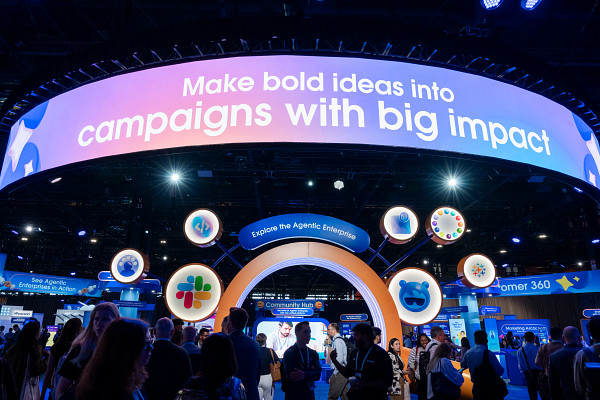

Over two days at Connections 2026, our team sat down with 15 marketers from brands including Frontier, IHG, GoodLeap, NAACP, Ben Bridge Jeweler and more. The leaders we spoke with all had different budgets, different team sizes and different customer bases. But the challenges and opportunities that surfaced were remarkably consistent.
I went into these conversations expecting to learn about the nuts and bolts of technology. What I didn’t expect was to hear the same word over and over, across industries as different as telecom and healthcare and fine jewelry. That word was trust.
We’re marketing in a moment when consumers are more skeptical, more distracted and more overwhelmed than ever. The brands earning loyalty today aren’t the ones with the biggest ad budgets or the flashiest tech. They’re the ones showing up consistently, saying things that matter and making customers feel genuinely seen.
Trust isn’t a nice-to-have anymore — it’s table stakes. And the marketers we spoke with at Connections are building it deliberately, one interaction at a time.
Here are five more things that surprised me in these chats.
1. Marketers are completely over generic messages
Waymon Hudson, Director of Customer Communications & Retention at Frontier, said his team had spent years sending generic messages to everyone in the base. He realized it was actively eroding the customer relationship. But what really stopped me was what he discovered trying to save at-risk customers with aggressive discount offers.
“If we immediately made them an offer, it reminded them — oh, I want to turn and leave,” Hudson said.
So instead of discounting, Frontier built trust journeys. Helpful, personalized, non-sales-driven content. No pitch. Just genuinely useful information tailored to where each customer was in their journey. And churn went down.
Watch Waymon Hudson of Fronteir talk about how his team built trust journeys.
Jennifer Brown, University of Tennessee’s Marketing Cloud Manager, agreed that batch and blast doesn’t work anymore: “We really need to get to the crux of it of what moves the needle,” she said.
One thing is clear: The era of sending the same thing to everyone is over. What’s replacing it isn’t just personalization — it’s relevance. And the best marketers have stopped conflating the two.
Take your mobile marketing up a notch
Kimberly Pope and other product experts will teach you how to deliver mobile messages that are rich, interactive and conversational at scale.



2. Bad data doesn’t just slow you down. It takes you in the wrong direction
Ben Bridge Jeweler VP of Technology and Digital Experience Eddie Delic had my favorite line of the entire two days:
“If we don’t get our data correct, the technology will be confidently wrong. It will convince you it’s right — but it’s wrong,” he said.
Watch Eddie Delic of Ben Bridge Jeweler talk about how his team uses data.
This stuck with me because it reframes something that most of us treat as a prerequisite — “getting the data right” — as something far more urgent. It’s not just a foundational task you check off before the exciting stuff begins. It’s the difference between AI that helps you and AI that misleads you with complete conviction.
And this wasn’t just one company’s observation. Marketers from Baptist Health, Black & Veatch, PDS Health and IHG all said some version of the same thing: the single most transformative step they took wasn’t adopting a new AI tool — it was getting their data unified in one place.
PDS Health’s Carrie Knipfer, Director, Brand and Patient Experience, put it in terms I won’t forget: one automated patient journey — triggered by a simple data insight about recommended-but-unscheduled dental crowns — generated $20 million in revenue. Not from a breakthrough campaign. Not from a new channel. From knowing which patients needed a nudge, at the right moment, with the right message.
That only works if your data is in a good place. If it isn’t, you’re not missing opportunities. You’re actively creating the wrong ones.


3. The time savings from AI are real. The best teams know how to reinvest them.
Everyone’s heard the promise of AI saving time. What I didn’t expect was how specific the numbers would be, or how deliberately teams were redirecting those savings.
- GoodLeap cut the time to deploy servicing communications from 4 hours to 15 minutes using AI agents.
- MIMIT Health reduced complex marketing campaign builds from four months to two hours.
- PDS Health saved 15 hours a week just by automating the manual process of announcing new dentists to patients.
- Indiana Wesleyan University’s Josh Grace, Executive Director of Enrollment Technology, put it best: “For a 10x person on your team, AI can 10x what they do.”
But here’s what surprised me: in every one of these conversations, the time savings weren’t being banked. They were being reinvested into strategy, into creativity, into experimentation they never had bandwidth for before. IWU’s team went from spending days on a single compliance campaign to generating segments, flows and multiple email templates in minutes, and then spent the reclaimed time getting better at the work, not just faster at it.
Watch Indiana Wesleyan University’s Josh Grace talk about the impact AI has had on his team’s productivity.
GoodLeap‘s Director of Marketing Operations and Data Eric Wooster had a clear philosophy on how to make this work: start with internal use cases before you ever touch the customer experience. His team first used AI to streamline campaign brief creation and reduce meeting time by 30–40%. That internal-first approach wasn’t just about efficiency. It was about trust. Once the team saw the results themselves, they became advocates, not skeptics.
“Start with small, internal efficiency use cases before rolling it out to external customer experiences,” Wooster advised. “That way as you scale, you have buy-in from your internal teams.”
Watch GoodLeap’s Eric Wooster talk about how his team uses internal use cases to build confidence in AI capabilities.
4. The brands winning on personalization are scaling humanity, not content
Frontier’s Waymon Hudson said something I keep coming back to:
“It’s really easy to scale content. It’s a lot harder — and a lot more important — to scale humanity,” he said.
This wasn’t an abstract philosophy. It was the insight behind a strategy that actually reduced churn. Not by sending more, but by making every communication feel like it came from someone who genuinely knew the customer and cared about them.
The NAACP’s Trovon Williams, SVP, Marketing and Communications, built on this in a completely different context. Managing a two-million-member organization across 2,200 branches, his personalization strategy isn’t a data model — it’s local micro-influencers who already speak the language of each community. For a major rally in Jackson, Mississippi, his team didn’t rely on national brand channels. They identified local voices who already had the community’s trust and let them carry the message.
“We sing from the same sheet of music, just different notes,” Williams said. “Overarching messaging is very much the same, but how I craft it for the audiences I’m speaking to has to differ depending on who we’re speaking with?”
Watch NAACP’s Trovon Williams talk about partnering with local influencers to build trust in communities.
And Ben Bridge Jeweler? Their entire digital strategy is built around arming in-store associates with data so they can deliver the kind of storytelling and human connection the brand has been known for for 110 years: digitally, at scale, without losing the soul of what makes a jewelry purchase feel meaningful.
What all three brands have in common: they’re not trying to replace the human moment. They’re using technology to protect it. To ensure it happens consistently, for every customer, at every touchpoint — not just when a great associate happens to be working that day.
5. AI adoption needs to focus on the humans
This was the most consistent theme across all 15 conversations — and maybe the least expected.
Black & Veatch’s Caitlin O’Malley, Senior Marketing Technology & Informatics Manager, said it most directly:
“It wasn’t just a tech project. It was a people project. That’s the strategy that doesn’t get talked about enough.”
Her team completed what she called her “Super Bowl” — migrating their entire marketing operation into Salesforce — and the biggest challenge wasn’t the technology. It was getting people off the workflows they’d built over years. It was earning trust. It was patience.
Watch Black & Veatch’s Caitlin O’Malley talk about how her team moved their whole operation to Salesforce.
Eric Wooster of GoodLeap’s advice: start with internal use cases before you ever touch the customer experience. Abby Bell of Simantel gamified AI adoption — complete with Harry Potter-themed competitions — because their creative team needed a reason to engage that felt like play, not threat. IHG’s Krishna Komanduri reminded the room: don’t chase every shiny object. Evaluate AI based on what actually drives priority value, then bring your teams along.
MIMIT Health’s Dr. Paramjit Chopra, Founder, President and CEO and one of the most advanced implementers in the room, put it in terms every marketer can use:
“If you have mice at home, your objective is to get rid of the mice, not to acquire the fanciest mousetrap. Find the simplest solution. In marketing, pick one platform and build up from there.”
The technology, every one of these marketers agreed, is the easy part. The real work is cultural.
Watch MIMIT’s Dr. Paramjit Chopra built a strategy to scale his team’s marketing operations.
What I took away from these Connections chats
Listening to 15 marketers over two days, what struck me most wasn’t any single data point or product announcement. It was this: the transformation happening in marketing right now isn’t primarily about AI. It’s about a fundamental shift in what we believe marketing is for.
The best marketers have stopped thinking in campaigns and started thinking in moments. They’ve stopped measuring success by send volume and started measuring it by whether a customer actually felt something: helped, seen, trusted.
Frontier’s Waymon Hudson said:
“The customer doesn’t care what your tech stack is. They care how they feel.”
That’s the insight I’m carrying out of Connections 2026. The tools are remarkable. But the intention behind them — the decision to use technology to scale connection rather than just content — that’s what separates the brands that are winning.
What’s the most surprising thing you’ve learned from your customers this year? I’d love to hear it!
Catch up on our CNX announcements
Miss Connections or want to revisit the biggest news from the event? Check out this briefing that recaps our product innovations and what they mean for you.











![Conservation activists and special guests discuss Jane Goodall's legacy at Dreamforce 2025. [Image: Salesforce | Jakub Mosur]](https://www.salesforce.com/blog/wp-content/uploads/sites/2/2025/10/DF25-SF-251015_MA22636.jpg?w=128&h=96&crop=1&quality=75)