
Patients Have Spoken: 5 Hard Truths About Healthcare Patient Experience in the Age of AI

New global research from Salesforce reveals what patients really want from AI, and the gap between expectation and reality is wider than most providers think.

Healthcare remains one of the few major sectors where the healthcare patient experience is hindered by persistent obstacles. Consumers continue to face long wait times on hold, are forced to recount their medical backgrounds at each appointment, and are often left to manage their own recovery process.
These are the same consumers who are increasingly accustomed to instant answers, proactive recommendations, and always-on support in nearly every other aspect of their lives.
Just two years ago, the idea of using AI to help fill this gap made patients uncomfortable.
Today, AI acceptance in the healthcare patient experience is widespread and even expected — with certain guardrails.
To better understand these changing perspectives, Salesforce surveyed more than 3,200 health consumers across eight countries for the latest Connected Health Consumer Report, The Health Consumer Mandate in the Age of Agentic AI. The findings reveal four key messages:
- Healthcare friction is driving patients away from care. AI has raised the bar on what good service looks like, and healthcare’s administrative burden is actively driving patients away.
- Patients are ready for always-on support via AI. Patients are broadly open to AI for logistical and navigational tasks, especially after hours.
- The biggest care gap often happens after the visit. For many patients, post-appointment care instructions lead to confusion, but AI may bridge this gap.
- Patients want AI, but only with guardrails. Patients are more open to AI in healthcare than ever, but only when transparency, oversight, and provider trust are built in.
Unlock What 3,200 Patients Expect from AI in Healthcare
See what 3,200 patients expect from AI in healthcare and how providers can close the gap.
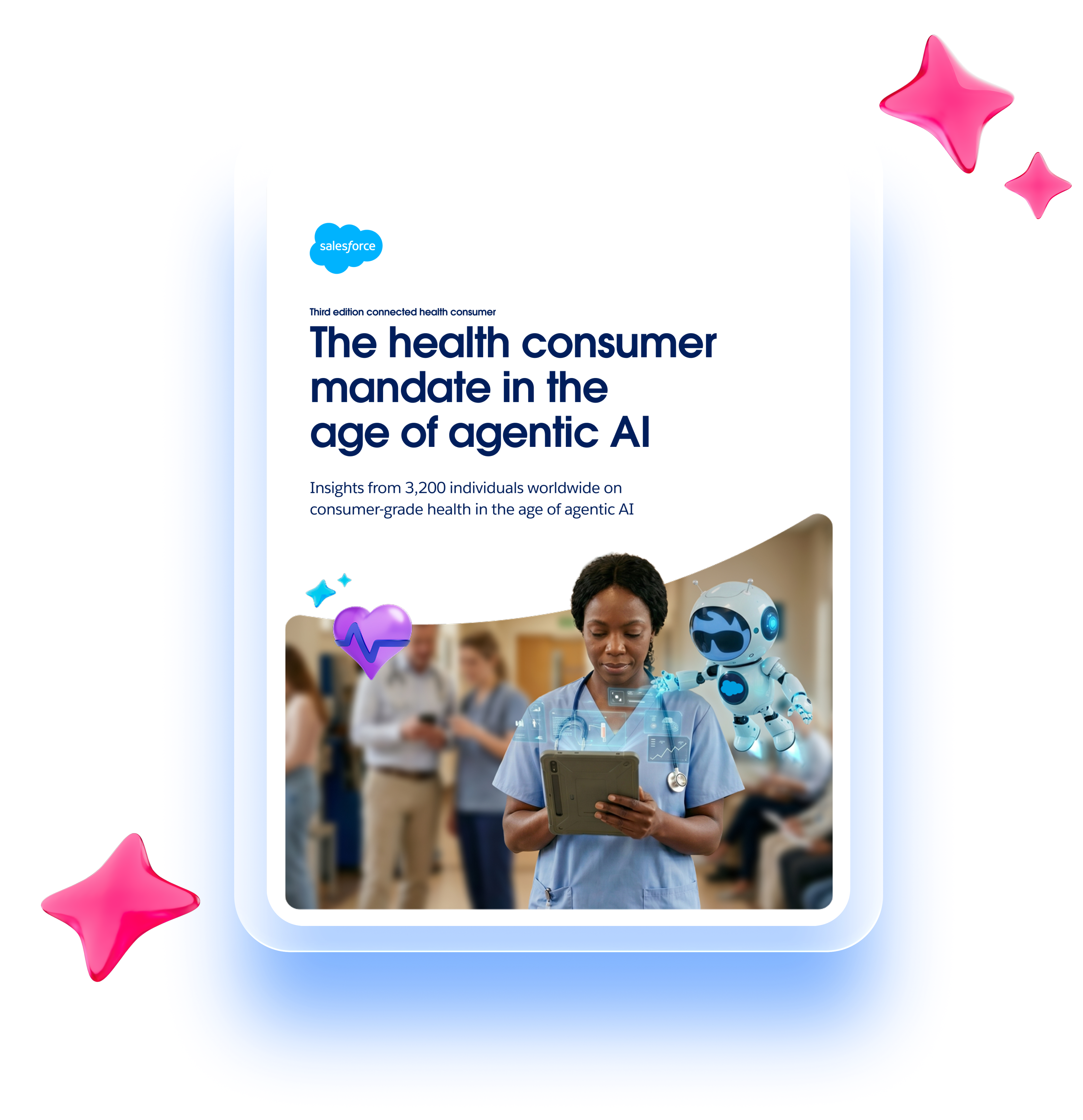
Here are five things patients are telling us about AI, and what providers can do about it.
Finding 1: Patients Want Healthcare That Meets Them Where They Are
For many patients, frustration begins before care even starts. Scheduling remains one of the biggest barriers to access, despite years of investment in digital tools. According to the research, 58% of patients will delay or even skip necessary care because scheduling is too difficult.
Digital tools like portals don’t always alleviate the struggle either. While immediate access eliminates wait times, 46% of patients say starting the process online is too confusing. This is why one in six patients now say ease of digital access is a deciding factor when choosing a new provider.
The stakes are higher than a lost scheduling opportunity. Patients abandoning care ultimately leads to gaps in quality, healthcare outcomes, and revenue.
“To rebuild and ensure patient retention, commercial providers must prioritize a seamless care journey of integrated communication, records, and scheduling,” said Amit Khanna, SVP & GM, Health Cloud, Salesforce. “For healthcare organizations, the key to meeting overwhelming demand lies in proactively intervening before costly emergency care or chronic condition management.”
Finding 2: Patients Want Answers at 11 p.m., Not a Callback on Monday
Availability is increasingly part of how patients define good care. Patient needs don’t disappear when offices close, but support often does. Providers who leave no option to connect with their patients in the evenings, on weekends, or between appointments leave patient loyalty on the table.
Always-on AI agents offer a potential solution to meet the rising demands for accessibility, responsiveness, and continuity of support. In fact, 67% of patients would rather have access to 24/7 help through an AI agent than wait to speak with someone during regular office hours.
For providers, always-on assistance can even be a retention strategy, as those that provide timely support can strengthen loyalty, improve continuity, and reduce friction throughout the care journey. Already, 44% of patients say a 24/7 agentic assistant would make them more likely to stay with a provider for follow-up care, while 55% would switch to a provider offering real-time, AI-driven insurance eligibility verification.
Discover the 5 Demands Redefining Patient Experience in Healthcare
Hear Salesforce experts unpack what patients expect from AI and what providers must do next.

Finding 3: Patients Want Guidance, and AI Is Emerging as a Post-Care Companion
One of healthcare’s biggest blind spots occurs after patients leave the appointment. Nearly one in four patients report leaving visits confused about their next step, treatment plan, or follow-up instructions.
Yet, 70% say proactive AI check-ins would help them stay on track between visits, signaling that care adherence often depends less on what happens during the visit and more on what happens afterward.
AI may bridge this gap by reinforcing instructions, answering questions, and providing timely reminders. This is especially true among Gen Z, as 31% say they would turn to AI first when unsure about next steps after an appointment — more than any other generation.
See How Agentic AI Boosted Transcend’s Patient Lifetime Value by 100%
Learn how Transcend used agentic AI for always-on patient support and achieved a 100% boost in customer lifetime value.


Finding 4: Patients Want Continuity Between Care Settings
A patient’s health is the sum of all the care they receive across medical settings, not a single appointment in an isolated location. Still, care outside of the primary provider (like at the ER) often goes unaccounted for, leading to confusion with discharge instructions, medication changes, specialist referrals, and follow-up appointments.
As a result, 90% of patients now wish their primary care physician automatically knew about these visits, highlighting widespread frustration with disconnected records and siloed communication. To address this disconnect, 77% of patients say they would highly value an AI tool that simplifies the handoff between hospital care and at-home recovery.
For providers, improving the discharge experience isn’t just about reducing readmissions or increasing awareness of each patients’ care. It’s an opportunity to strengthen trust, improve outcomes, and build long-term loyalty by ensuring patients feel supported beyond the walls of the hospital.
Finding 5: Patients Want AI — Within Trusted Guardrails
Patient attitudes toward AI have shifted considerably in the last few years. Today, 64% of patients say they would share their full medical history with AI for faster diagnosis. Despite this increased willingness, patients still want a say in how AI should operate, making trust a prerequisite.
Where the AI lives and who’s accountable for it matters. Patients are three times more likely to trust AI in their provider’s portal over a public chatbot. Even then, 89% want a clear “escalate to a human” option when AI is used for administrative support; 90% when it comes to AI for medical support.
Provider-embedded AI with clear governance is not only safer, it’s a competitive differentiator. As patients increasingly seek providers that are responsive and easy to engage with, 62% say they would trust an AI agent integrated into their doctor’s secure portal more than a public AI chatbot.
The Providers Who Listen Will Lead
Patients have already decided that AI has value in healthcare. What they want isn’t “futuristic tech” for its own sake, however. It’s AI-supported answers that are easier to access, available when they need it, connected across the care journey, and supported by trusted guardrails.
Providers that deliver on these expectations will be better positioned to earn patient trust, strengthen loyalty, and improve outcomes.
To deliver:
- Start by reducing administrative friction. Focus on scheduling, referrals, billing, and other processes where patients feel frustration most. Since patients are most receptive to AI support in these areas, agentic AI that automates these high-friction interactions and frees staff to focus on more complex patient needs poses the easiest wins.
- Connect the full care journey. Patients don’t think in silos. Scheduling, visits, discharge, and recovery should feel like one continuous experience. Agentic AI can bridge the gap between care settings by proactively sharing updates, coordinating follow-up activities, and helping patients navigate next steps.
- Build trust through transparency. Patients have made it clear that trust in AI depends on strong governance, human oversight, and clear lines of accountability. No matter how you choose to incorporate AI, be transparent about when AI is being used, how decisions are made, and when a human can step in. Above all, choose AI solutions with built-in data security and HIPAA compliance.
The future of the healthcare patient experience won’t be defined by AI alone. It will be defined by how effectively providers use AI to remove friction, create continuity, and help patients feel supported at every step of their journey.
Transform Patient Experiences With Agentforce 360 for Health
See how Agentforce helps providers and payers deliver seamless, always-on patient and member experiences.