13 ways to use conversational AI to improve customer service
Discover how teams use conversational AI to deliver faster, smarter, and more inclusive customer service, backed by new statistics.


Discover how teams use conversational AI to deliver faster, smarter, and more inclusive customer service, backed by new statistics.


When your customers need you, they expect to be able to communicate with a representative straight away. In today’s market, where 43% of customers will switch to a competitor if they receive poor service, it’s important to use customer service opportunities not just to fix a problem, but to build lifelong loyalty.
While great customer service was often seen as a point of difference, it’s now table stakes. In fact, we found that 82% of service professionals agree that customer expectations are higher than they used to be.
To tackle this heavy competition and high expectations, teams are turning to conversational AI. With 69% of companies now using AI (up from 24% in 2020), customer care is entering a new era of speed and personalisation. Conversational AI helps teams manage higher case volumes, offer 24/7 assistance, and deliver more consistent experiences.
In this article, we’ll look at how teams are using conversational AI to improve customer service, using insights and statistics from Salesforce’s 7th Edition State of Service Report , where we gleaned insights from more than 6,500 service professionals worldwide on customer support in the AI era.
Here are 13 ways you can deploy conversational AI to take your customer service to the next level.

You can scale your customer service with the power of generative AI on a unified foundation of trusted data. See how this technology improves efficiency and generates revenue from the contact centre to the field.
In every other part of your customers' lives, speed and convenience have increased over the last 10 years. If they need food, they Uber it; if they need to watch a movie, they open Netflix. This same desire for instant gratification now applies to service.
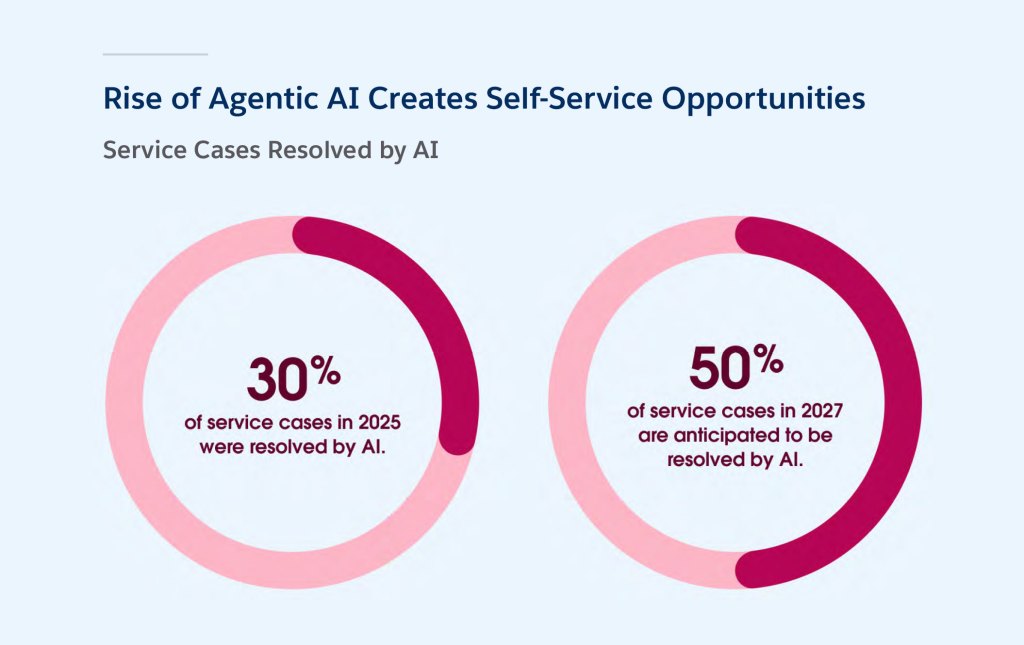
However, as most teams know, it’s not realistic to be everywhere at once, responding thoughtfully and quickly. These higher expectations have led teams to bring in AI as a support agent (Agentforce) to assist them with their work, overseen by human judgment. In fact, we found that 50% of service cases are expected to be resolved by AI by 2027 (up from 30 % in 2025).
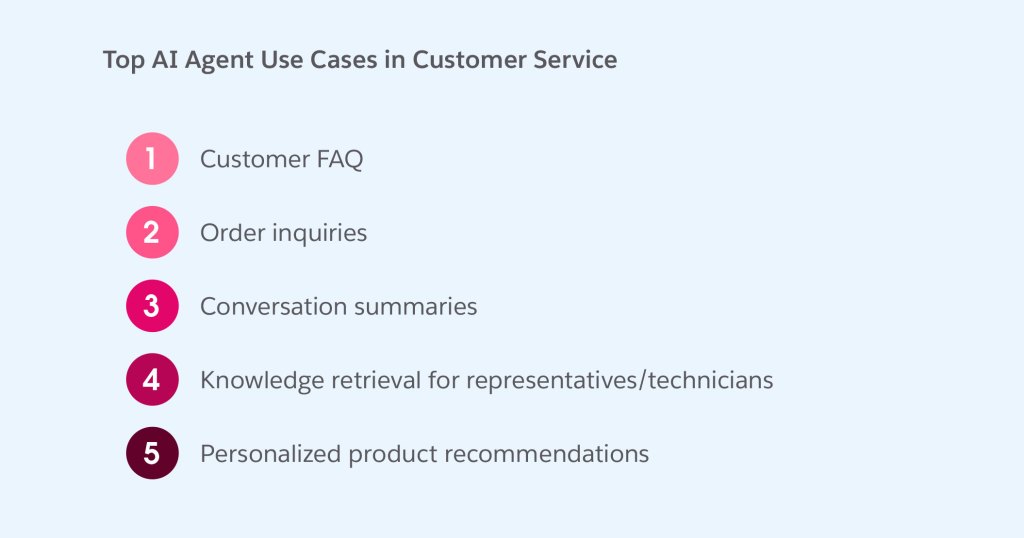
Customer service software with AI is a great option for first-line responses to customer queries. Many teams are already using it to take the resolutions they’ve previously given to customers and turn them into knowledge base articles. In fact, we found that this is the number one use case for customer service teams using AI (followed by order inquiries).
By using generative AI to create and update FAQs, customers can find accurate answers themselves without needing to contact a representative. This saves time; it also feels easier and faster for the customer.
One example of success can be seen from Fisher & Paykel, which now offers 24/7 support using Agentforce. Based on this change, Fisher & Paykel expects to more than double self-service rates, reaching more than 65%.
Fisher & Paykel Delivers Luxury Service at Scale With Agentforce
There are only a handful of times that a brand actually gets to speak face-to-face with its customers. Support is the frontline of customer interaction. This is why, when a customer reaches out for support, it’s a bigger opportunity than simply solving their issue. It’s also a chance to learn more about their needs and how your business can be their standout provider.
When you get this information, you can use AI-driven selling. This works by connecting your CRM and service data. From there, AI can analyse customer preferences, purchase history, and behaviour to make personalised suggestions. These recommendations turn ordinary service conversations into meaningful sales opportunities that feel natural and helpful, not forced.
We found in our State of Service Report that offering personalised product recommendations is one of the top AI use cases in service. With tools like Service Cloud, teams can use data insights to provide specialised suggestions that build relationships and sales (watch the Service Cloud demo). In practice, a SaaS company could use AI to spot when a customer asks about features not in their current plan, and then send an email offering an upgrade for what they need.
One great example of this can be seen from the jewellery brand Pandora. They built an AI assistant using Salesforce's tools and called it Gemma. Gemma helps customers find the perfect piece by learning about the occasion, recipient, and budget, and then suggests items that match. Behind the scenes, Agentforce connects this data from Service Cloud and Agentforce Commerce to make each recommendation relevant and on-brand.
Want to learn more? Watch David Walmsley, Chief Digital and Technology Officer at Pandora, share how using the full Salesforce suite has transformed their operations. You can watch this and more on Salesforce+.
Customer service teams spend hours reviewing chat logs and call notes to understand what’s already been discussed with a customer. This is repetitive work that slows down response times and can easily lead to missed details. Generative AI allows them to automatically create quick, accurate summaries of customer interactions.
Through implementing AI to compile key points from past conversations, agents can get up to speed in seconds instead of minutes. This means less time spent digging through old messages and more time focused on resolving the issue at hand.
In our latest State of Service Report , we found that conversation summaries are now the third most common use case for AI in service. Health technology company Magentus is a great example of how this can play out. Using AI to generate post-call summaries within one customer stream, they were able to reduce customer wait times by a huge 60%.
With Agentforce and the Einstein Trust Layer, we can build autonomous agents customised to the needs of our business and harness AI without compromising on our security standards. We can also apply the power of AI to improve the experiences of our customers and employees.
Gavin SladeSalesforce and Systems Enablement Manager, Magentus
When a customer needs urgent help, it can feel frustrating to wait while an agent searches in real time for the answer. Outdated tools and messy systems make it harder to respond quickly and keep your customers happy. AI fixes this by pulling up the right answers instantly during live conversations.
Instead of switching between tabs or searching through long documents, agents can see the right information in real time. This makes it easier to solve your customers' problems the first time they contact you and keeps the advice given by different support representatives consistent.
In our State of Service Report , we found that knowledge retrieval ranked as the fourth most common AI use case in customer service.
One business using knowledge retrieval to improve its customer experience is TripADeal. Using Agentforce and Data Cloud, they built an AI agent that instantly gives answers and personalised travel recommendations. The AI agent does this by using Retrieval-Augmented Generation (RAG) to search across unstructured data. The result has been that all their customers receive quick, relevant responses no matter what timezone they are in.
How TripADeal Uses Agentforce to Deliver Personalised Travel at Scale
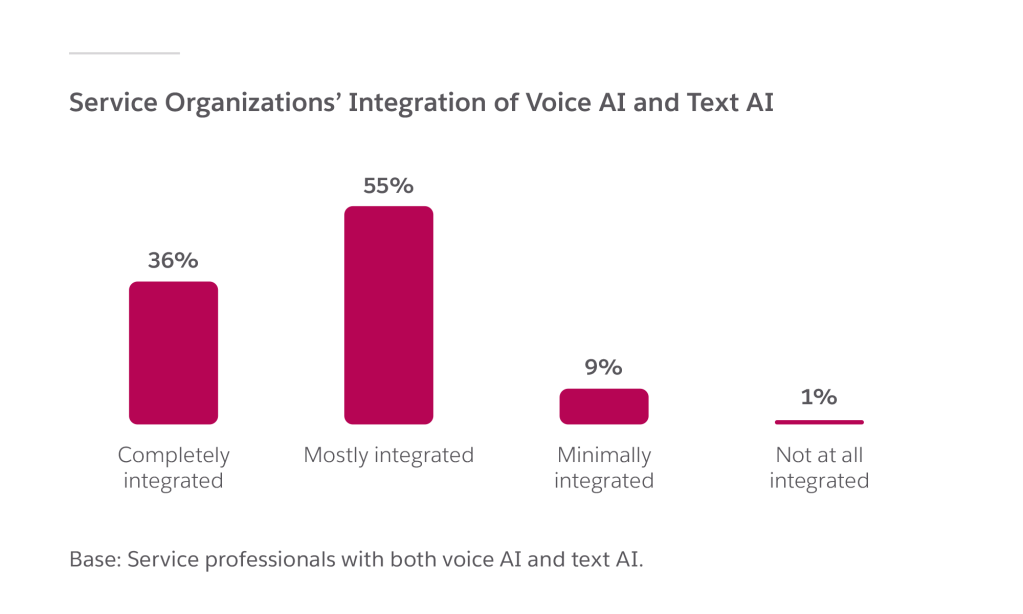
Customers want to connect with businesses in a way that suits them, whether that’s by phone, chat, email, or text. However, this often means conversations don’t carry over between channels, leaving customers needing to repeat themselves or receiving different advice from different representatives. Multimodal AI fixes this problem by allowing you to connect voice, chat, and text into one continuous conversation. In our latest State of Service Report , we found that 36% of organisations using both voice and text AI support have already connected them.
When a customer switches from a chatbot to a call, your AI agent (which is connected to Service Cloud) will be able to show you instantly the full chat history and context. This creates a smoother experience and eliminates having to start over. It also improves job satisfaction for service reps by helping them deliver faster, more helpful support that customers genuinely appreciate.
Looking into the future, research like Google’s DeepMind’s AMIE project shows where conversational AI is heading next. In this study, AI was able to understand and respond to multiple types of information – not just text or voice, but also images. In customer service, this could lead to AI agents that can review a screenshot, receipt, or product photo during a chat to better understand the issue and offer the correct solution.

Deliver personalised customer service at scale. Bring all of your support needs onto one platform so you can decrease costs while increasing efficiency.
Tone and emotion play a huge role in customer service, and a good representative is able to adjust their approach based on that. Until recently, AI couldn’t recognise tone or emotion, which made it difficult to use it in a way that felt genuine.
AI can now detect tone and frustration in real time, helping service teams respond with the right level of care. It can flag when a customer sounds upset, suggest when to escalate a case, or even coach agents on how to adjust their tone mid-conversation.
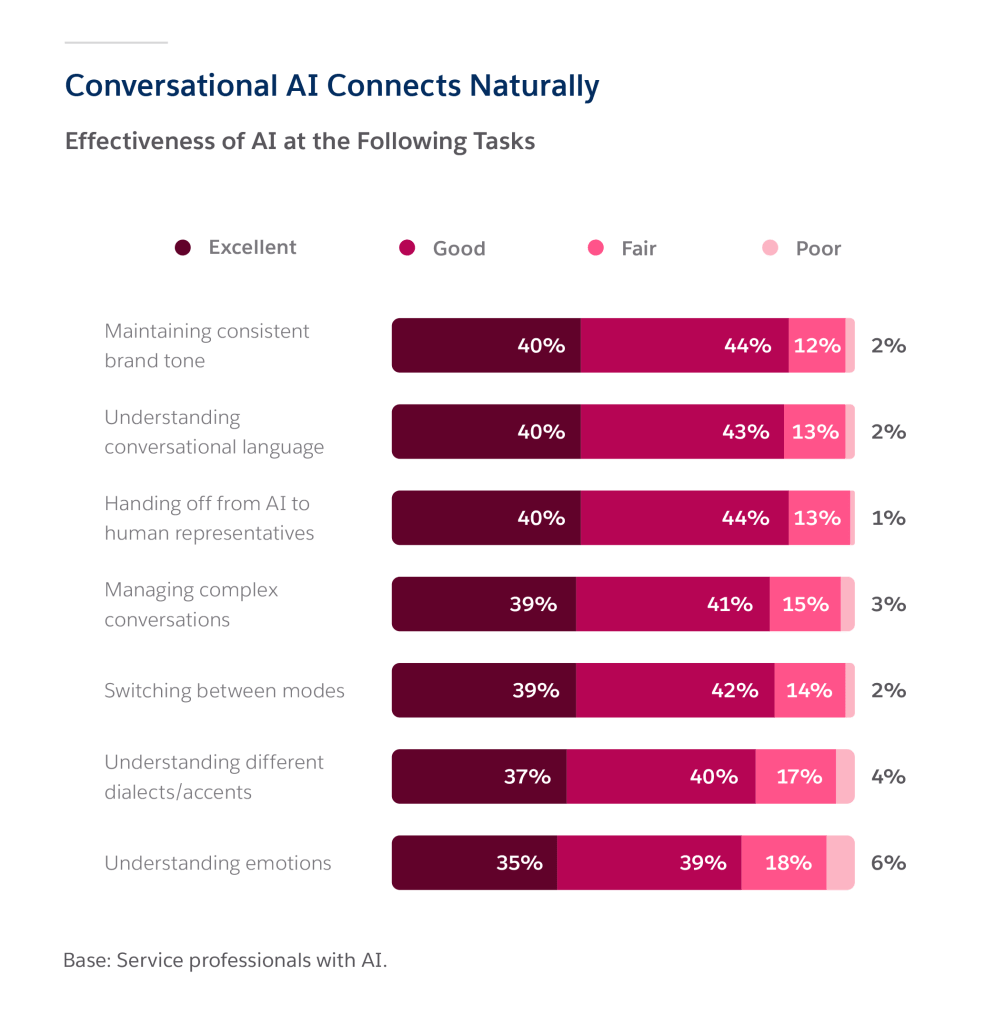
In our State of Service Report , we found that 35% of service professionals said their AI tools are already excellent at understanding emotion.
One example of this in action is at McDonald’s . They now use emotion and tone tracking technology across more than 38,000 locations and online to monitor customer sentiment in real time. For instance, if a new menu item receives negative feedback or a store isn’t meeting expectations, McDonald’s can act on that data right away.
Humans are masters of noticing small tonal changes and can easily spot when a conversation sounds ‘off’. A friendly tone in one interaction and a robotic reply in the next can make the experience feel disingenuous. This either means your customers' trust is eroded, or your team has to spend hours each week touching up AI text.
Conversational AI helps solve this by mirroring your brand’s voice and tone, no matter where or how a customer reaches out. When you train AI models on your brand’s language library and tone guidelines, you can make sure that your messages sound consistent. In our State of Service Report , we found that 88% of companies said their AI tools are good or excellent at maintaining a consistent brand voice.
Having a consistent brand voice can be helpful across automated chat responses, follow-up emails, or social media messages. For example, if your brand leans into a relaxed vibe, it makes sense for your bot to start a conversation with “Hey there 👋”. However, this would feel inappropriate coming from a prestigious university.
Customer service should be easy for everyone to access, regardless of their primary language or ability. However, many systems still have barriers for those who don’t fit neatly into a single way of communicating. Conversational AI can help break down some of those barriers.
In our State of Service Report , 88% of service professionals said conversational AI has improved their accessibility for more diverse customer groups. These tools (like Agentforce) can do this by translating conversations in real time, offering built-in support for multiple languages.
Research has also found that it makes a big difference for neurodiverse minds . Chatbots allow people to ask as many questions as they need, take extra time to read and process information, and respond at their own pace. For many, it removes the pressure of a phone call or in-person interaction, creating a calmer and more comfortable support experience.
The result of higher levels of inclusion leads to a better experience for everyone involved (customers and service reps).
Even with the rise of automation, some customer problems are too complex or sensitive for AI to handle alone. That’s why the most prepared service models combine both the human expertise of their people with the speed of AI.
In practice, AI can triage simple requests, like password resets or order tracking, so human agents can focus on high-impact issues that require empathy, judgment, and creative problem-solving. This collaboration helps teams resolve customer issues faster while keeping morale high, since agents spend more time on meaningful work rather than repetitive tasks.
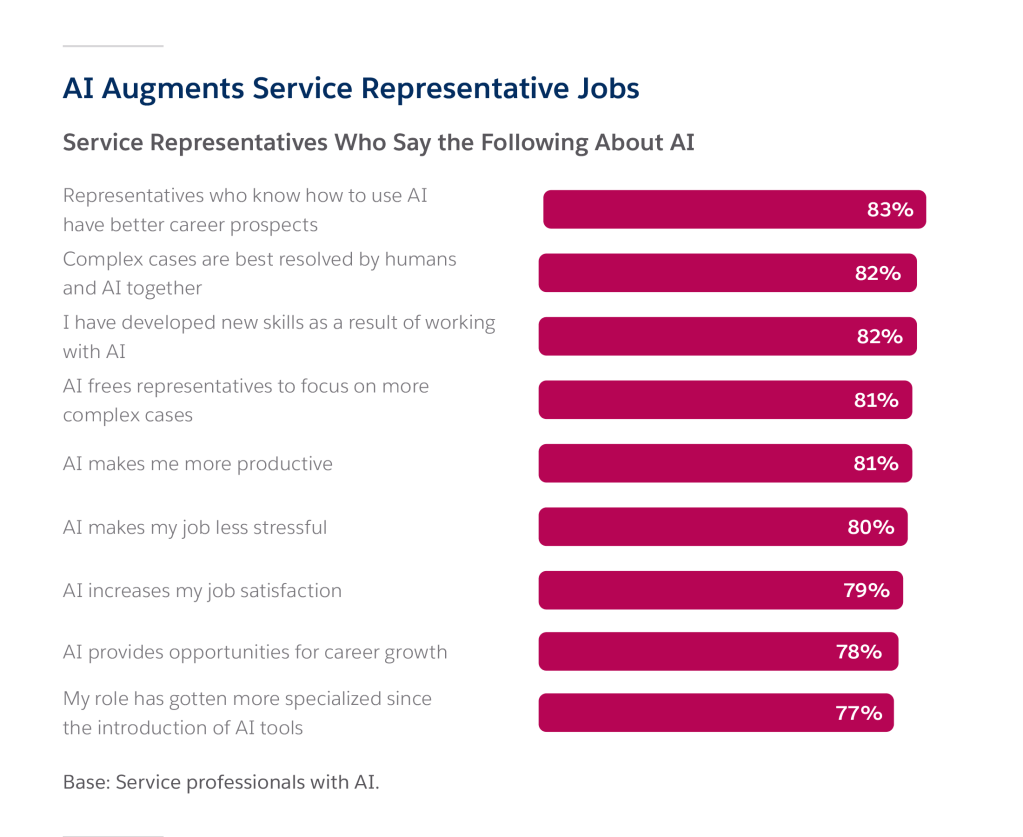
In fact, we found in our State of Service Report that 82% of service professionals said complex cases are best resolved when humans and AI work together.
A strong example of this in practice comes from One NZ, which uses Agentforce 24/7 to help its prepaid customers transition to new plans. The guardrails set in place by One NZ prevent the AI from allowing incomplete transactions, while complex questions are automatically escalated to human representatives.
Agentforce’s ability to access data in the moment is vital. The agent is grounded in the right answers and can only look at the data that is relevant for each particular customer according to the rules we set for it.
Summer CollinsChief AI and Data Director, One NZ
Great customer service doesn’t sit back and wait for problems to appear; they actively work to prevent them. Predictive AI helps teams do this by spotting early warning signs based on customer data, usage patterns, and past interactions.
For example, if a customer is constantly struggling to use the product or their subscription is about to expire, Salesforce’s AI can alert the service team before the issue escalates. This allows agents (either AI or human) to step in early, offer help, and improve your customer relationships through proactive support.
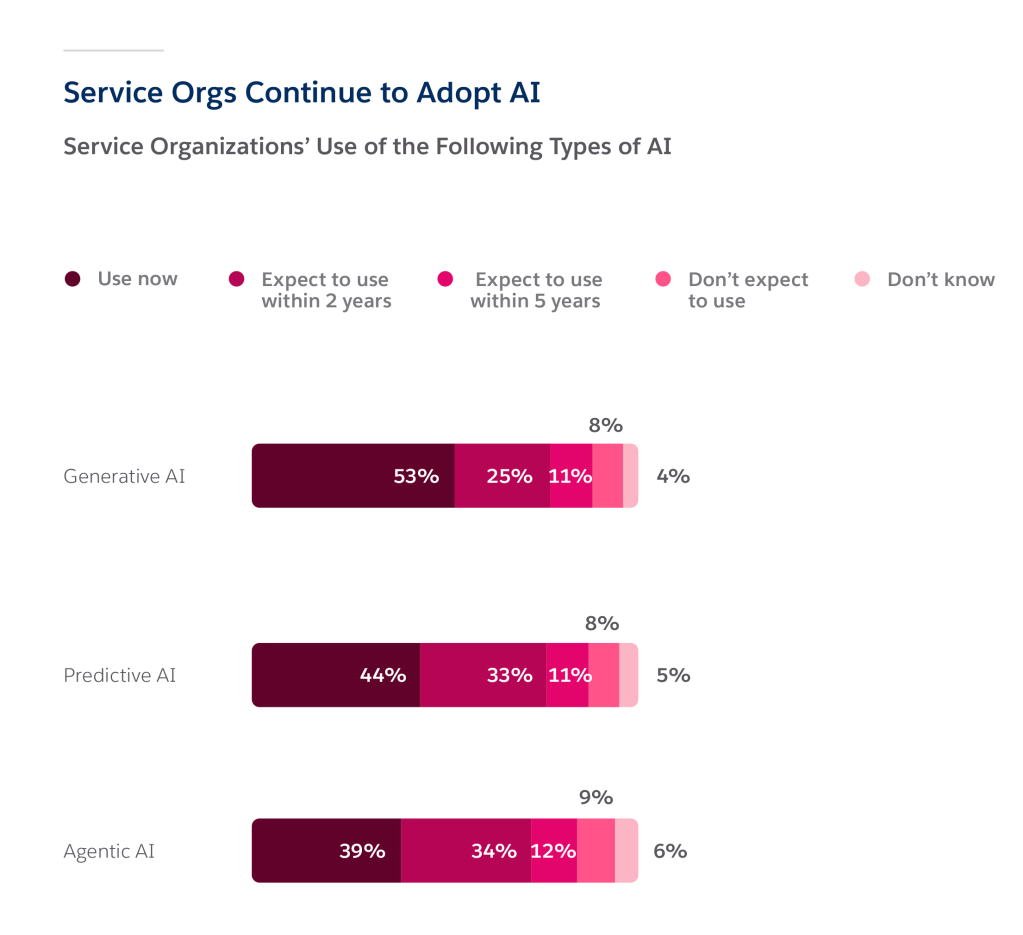
All of these benefits are perhaps why we found in our State of Service Report that predictive AI is already being used by 44% of service teams.
A clear example of predictive AI in action can be seen from Amazon . Their new AI model predicts what customers will need to help prevent delays and supply chain issues before they happen. Through analysing trends like demand, seasons, and local weather, it can make sure it has products in the right place at the right time.
Every customer service team has to do repetitive tasks that take up time; these are often things like updating records, storing documents, or sending follow-up emails.
Using AI automation, these frequent jobs can now be done automatically. This gives service reps more time to focus on the complex cases and customer relationship-building activities that need a human touch.
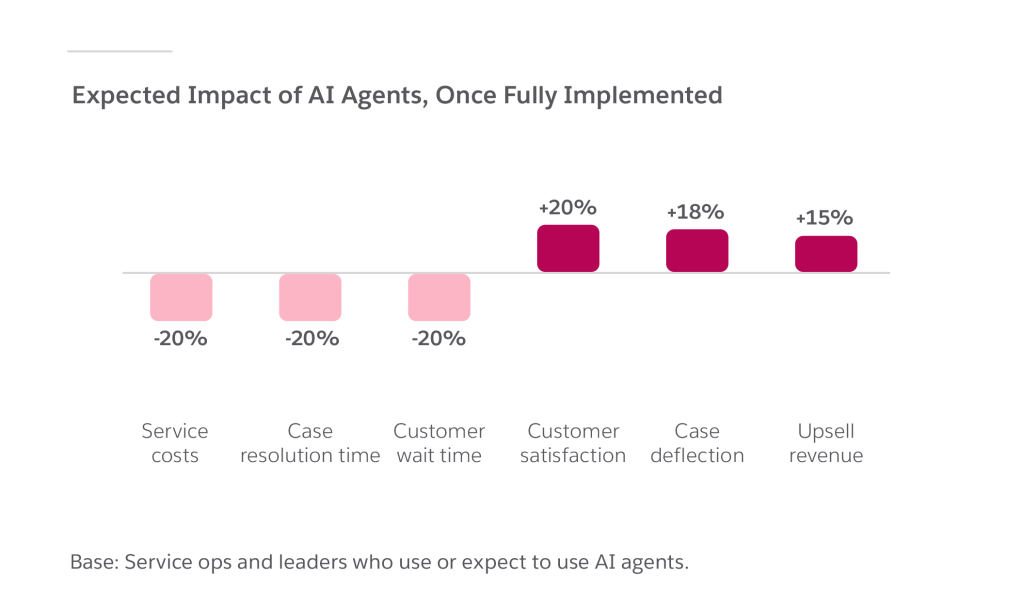
According to our latest State of Service Report , service leaders using AI agents expect both their service costs and case resolution times to drop by an average of 20%. That’s a huge win for teams under pressure to do more with less.
One great example of this can be seen at BizCover, which supports more than 200,000 small businesses. Using Service Cloud, they’ve automated much of their customer communication and case management. This has contributed to an average NPS of over 74 over the past six months, with some months over 80.
AI is only as strong as the data behind it. When customer information is spread across different platforms, it’s harder for AI to make accurate predictions. When businesses are able to bring all their service data together in one place, they can get the full potential of their AI tools.
In the State of Service Report , companies that have unified their service channel data on a single platform are 1.4 times more likely to describe their AI implementation as very successful.
A great example of this success comes from Kellanova (formerly Kellogg's). They brought in data from their more than 20 systems together in Data Cloud. After doing this, they were able to reduce the time it takes to address refund claims by 99.8%.


Conversational AI can now act as a real-time coach, offering instant feedback and guidance during live interactions. For example, it can suggest how to phrase a response more clearly, when to show empathy, or when to escalate a tricky case. In our State of Service Report , we found that 82% of service professionals said AI has helped them develop new skills, and 83% said it’s improved their career prospects.
This kind of coaching helps service teams gain confidence and sharpen their skills while on the job. It also gives managers better insight into individual performance trends, making it easier to deliver personalised training and recognise top performers.
One example of this can be seen from Precina, a healthcare company that used Agentforce and Health Cloud to train new clinicians on patient intake calls. Typically, this kind of training was resource-heavy and hard to scale. When they started using AI coaching, clinicians could practice real patient scenarios and receive instant feedback. This always-on training model helped Precina grow their team while always improving the quality and consistency of their support.

Get inspired by these out-of-the-box and customised AI use cases, powered by Salesforce.
Conversational AI is changing how businesses deliver great customer service. It helps customers find answers faster, supports agents with helpful tools, and makes service more inclusive for everyone.
AI agents like Agentforce are already supporting businesses, governments, and nonprofits around the world. “Agentforce helps us scale our impact and reach more communities with the resources they need,” said Stéphane Moulec, CTO at Good360 .
To see how AI can elevate your customer service, explore Agentforce and the full Salesforce suite.
If you want to see what the future of customer service looks like, along with highlights from Dreamforce, visit our streaming service, Salesforce+.
Try Service Cloud free for 30 days. No credit card, no installations.
Tell us a bit more so the right person can keep in touch faster.
Get the latest research, industry insights and product news delivered straight to your inbox.
Modern AI technologies are changing customer service by handling thousands of conversations at once, analysing patterns, doing sentiment analysis, and delivering fast, accurate replies.
These AI-powered chatbots and virtual assistants use natural language processing and machine learning to understand context and customer emotions, which helps them respond more accurately to complex queries.
Conversational AI typically supports service reps by doing their routine tasks and speeding up things they do daily. Here are some of the most common ways it’s used:
Most customers now expect some form of conversational artificial intelligence to be used to help provide support, especially when they are using live chat.
When designed well, conversational interfaces can still feel intuitive and helpful by using natural language understanding to interpret tone, emotion, and intent. With that said, most customers would still like to know when they are talking to a bot and have a clear option to talk to a human agent if needed.
Conversational AI interacts with people through text or voice. Generative AI creates new content like emails or summaries. Predictive AI analyses data to forecast what might happen next, like spotting a problem before it occurs.
When AI in customer service handles simple inquiries or automates ticket management, your team can focus on work that truly improves the customer experience.
This might include upskilling them in report generation and analysis, project management, or cross-team communication. As artificial intelligence (AI) takes care of the repetitive work, your staff can grow their strengths in places AI can’t replace, like emotional intelligence, creative problem-solving, and leadership.