


Unstructured Data Guide: What It Is, Use Cases, and Benefits
Unstructured data is information not stored in predefined formats, including text, images, audio, and more. Learn about its significance and analysis methods.
Unstructured data is information not stored in predefined formats, including text, images, audio, and more. Learn about its significance and analysis methods.

Unstructured data is data, such as images, text documents, social posts, internet of things (IoT), videos, emails, photos, and audio files, that lacks a set format and is hard to organise in rows, columns or fields. As a result, it’s harder to store, process, and retrieve. While this data is harder to search, it’s packed with valuable insights such as customer feedback, perceptions, opinions, tone, and sentiment. The good news? You have a treasure trove of it. In fact, IDC estimates that by 2028, up to 90% of data of the 400 zettabytes generated will be unstructured. But only 40% of resources are directed to harnessing unstructured data, the rest going to structured data. So most of its potential remains untapped, preventing organisations from deepening their understanding of customers, enriching customer profiles even further, and creating contextually rich AI and Customer 360 experiences.This guide will explain unstructured data, how it’s used, how it differs from structured data, and where to find it so you can realise its full potential.
Unstructured data vs. structured data
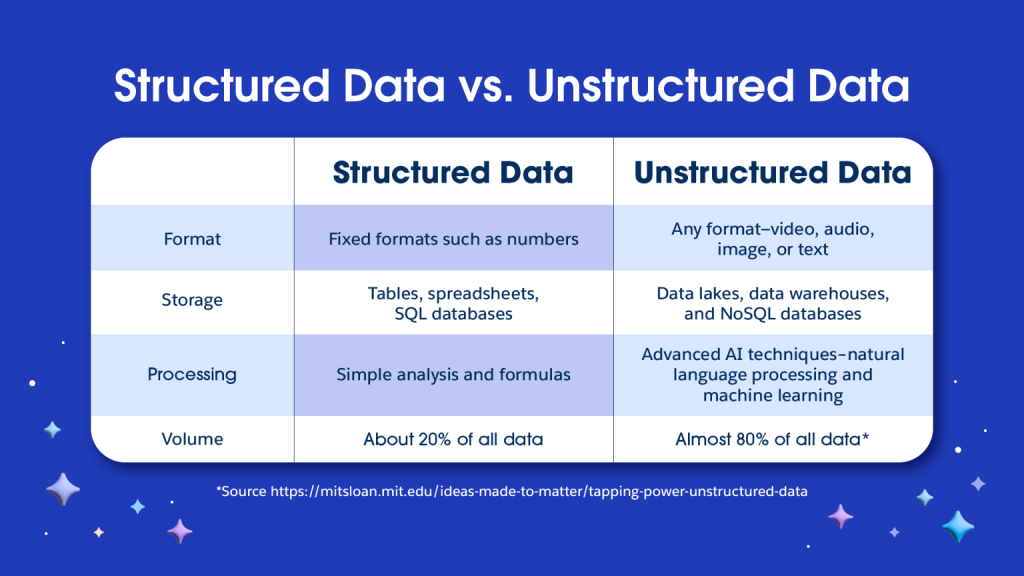
Think of unstructured data as the unruly sibling and structured data as the compliant one. They each bring their own gifts and potential in your family of data.
Let’s look more specifically at how structured and unstructured data differ.
Unstructured vs. semi-structured data
Semi-structured data is the middle ground between structured and unstructured data — it doesn’t have a predefined schema like structured data, but it can be stored and searched more easily than unstructured data. Semi-structured uses metadata, such as tags or semantic markers, to create a hierarchy and to separate distinct elements within datasets. For example, the raw data from an audio recording is unstructured but the audio transcript with a tagged headline, snippets, or alt-text is semi-structured.
Unstructured data examples
Unstructured data can take so many forms. Let’s look at its most common sources in the everyday digital landscape.

Text files
Text files are usually rich with unstructured data. You’ll find it in customer emails, notes, customer logs, and chatbot chats. Your pdfs can also contain unstructured data.
Multimedia content
If you’ve heard the term “big data”, you probably know that most of it is multimedia. According to Troy Beamer, the US correspondent of Tech Business News, our digital world is estimated to generate over 400 terabytes of data daily in 2025 — much of it in the form of videos, digital photos, audio files, podcasts, and medical images. Every time you join a digital meeting or conference you generate unstructured data. Your security camera footage is full of unstructured data, and so is every customer video and webinar you record.
Social media
X, LinkedIn, Facebook, TikTok, Instagram, and YouTube are some of the most popular social media sites. Each channel contains troves of unstructured data. YouTube videos, customer interviews, Instagram comments on your recent post, and Facebook posts are examples of unstructured data.
Websites and markup language
Your company’s website is brimming with unstructured data. HTML and XHTML provide markup tags that serve as the building blocks for web display, but the content between the tags is unstructured.
Mobile and communications data
How long can you go without your phone? Each voicemail you generate and retrieve, and each customer message, is rich with unstructured data. Messaging data falls in this category too.
Machine and sensor data
IoT devices and sensors are loaded with unstructured data. A grocery retailer, for example, may use IoT sensors to monitor and optimise food storage temperatures. Data from medical testing, weather monitoring systems, motion sensors, and GPS systems is also unstructured.
Historical archives
Archived documents, scanned historical records, and other such data you have collected over the years in external hard drives or network drives is often unstructured. Government agencies usually retain a lot of unstructured historical data in their archives.
Your company’s unstructured data can be a source of compelling insights into your customers, market, and business performance.
Let’s look at four powerful use cases for unstructured data.
Artificial intelligence: No matter how advanced your AI models are, they're only as good as the data they work with. For AI agents to understand your customers and business, they need access to your proprietary data. Without this information- which primarily lives in all kinds of unstructured data - they produce generic, unreliable results. But how can you actually get this information to AI agents? That's where vector databases and retrieval augmented generation (RAG) come in.
A vector database is designed to store and manage unstructured data by converting it into numerical "vectors" that capture its meaning and relationships. This allows AI to easily find patterns, such as identifying similar images or analysing sentiment in customer reviews, making it simpler to process and understand complex, unstructured data.
While large language models (LLMs) excel at generating responses using public data, RAG enhances these responses by bringing private enterprise data stored in vector databases or data lakes to the AI-generated response. This brings further context to the question being asked to AI and improves accuracy, making it ideal for real-time or domain-specific tasks like customer support or detailed reporting.
To sum it up: A high-quality, unified data foundation – rich with insights from all your data, especially your unstructured data–is essential because it ensures that your AI agents are making decisions based on the most accurate and up-to-date information about your business and customers. Using technology like vector databases and RAG can bring insights from unstructured data to AI agents, empowering them to make decisions and take meaningful actions. Unstructured data is essentially the foundation that makes AI – particularly generative and agentic AI – possible.
A global Iron Mountain - FT Longitude research found that in 2025 Indian organisations, at 45%, lead the world, in prioritising AI-powered decision-making and agility as the main goal for their unstructured data initiatives over the next two years.
Source: 70% of Indian Organisations See Benefits from AI-Readiness: Iron Mountain Report
Improving customer experience
Unstructured data sources, like customer service calls, transcripts, customer feedback, sensor data, and social media, can elevate customer service in numerous ways. For example, analysing call transcripts can help you spot common issues and improve your self-service options, making it easier for customers to find answers on their own. Sensor data from products, like cars, can predict when maintenance is needed, so you can reach out to customers before problems happen. Social media feedback can help you update your self-service content and make it more relevant, ensuring customers get the help they need faster. And when you use the power of AI, data and CRM to bring all this data together into detailed customer profiles, you can move from proactive service and even turn service into sales opportunities.
Sales performance optimisation
Analysing unstructured data from sales emails, CRM notes, and meeting recordings helps you learn about your customers and how customers perceive your product and their intent to buy. For example, you can look for trends that have led to successful deals in the past or keywords your buyers use frequently that may explain a recent drop in sales.
You can use these new learnings to refine your sales strategies, retain your customers, and personalise your products or services.
Fraud detection
With the dramatic increase in the amount of data we generate daily has come a dramatic increase in cyberthreats. In recent years, data security and protection have become top priorities for most executives and data experts.
Unstructured data from online transactions, emails, chat logs and other sources can help your security teams identify anomalies and flag potential threats. For example, an unusual phrase or transaction pattern may indicate fraudulent activity. Combing through unstructured data for red flags with fraud detection automations can help your organisation monitor and prevent cyberattacks and the risks they pose — financial and reputational damage.
Here is a glance at how Indian businesses can unlock value from their unstructured data, helped by government initiatives.
Benefits of unstructured data
Challenges of unstructured data
In 2025, 53% of Indian organisations told Iron Mountain that AI-powered analytics for data quality control and assurance had been the most beneficial tactics for improving their unstructured data so far.
Source: 70% of Indian Organisations See Benefits from AI-Readiness: Iron Mountain Report

The right data strategies can make all the difference when it comes to managing data throughout its lifecycle. Let’s look at three best practices for unstructured data.
1. Align business goals with unstructured data strategies
Start by identifying key objectives — whether it's improving customer engagement, simplifying operations, or improving decision-making — and determine how unstructured data can help you achieve your objectives. For example, if your goal is to boost customer satisfaction, consider analysing customer reviews, support emails, and customer social media reactions.
Linking unstructured data strategies to specific goals will keep your efforts focused and measurable. It will also help you prioritise what types of unstructured data to gather and analyse.
2. Building a unified data management framework
A unified data management (UDM) platform consolidates and unifies your data sources within a centralised repository. Setting up a cohesive data framework in your platform will keep your data, regardless of format, accessible, usable, and secure. Your data management framework should ideally incorporate protocols for data ingestion, metadata tagging, and centralised storage solutions such as data lakehouses or hybrid cloud environments.
Your data framework should also incorporate clear data governance policies. This way you can maintain data quality and stay compliant with regulations, which is particularly important in industries such as finance and healthcare.
3. Using Data Cloud to activate your unstructured data
Data Cloud is a platform that unifies your unstructured and structured data on the Salesforce platform regardless of where it comes from. Because it is integrated with the Salesforce metadata framework, you can turn data into the standard objects and fields your teams already know and work with.
Check out our infographic, “5 Winning Strategies to Activate Unstructured Data”, to see how Data Cloud transforms untapped unstructured data into business value.

Then, watch how Data Cloud streamlines business processes, as it surfaces critical customer context hidden in unstructured data – like pdfs, audio files, and videos – directly to autonomous AI agents.
Unstructured data is information without a fixed or organised format.Unlike structured data—which is arranged in rows and columns, like in spreadsheets or CSV files—unstructured data is more complex and diverse. It is valuable because it captures a large chunk of everyday personal and business communication.
You’ll find unstructured data everywhere: emails, presentations, videos, medical imaging, WhatsApp chats, social media content, GPS data and data captured by IoT devices. As digital communication grows rapidly across India, the volume of unstructured data continues to rise.
Unstructured data accounts for the majority of data generated daily in India and worldwide. Analysing this data can reveal useful insights about customer opinions, feedback, emotions, and buying behaviour that structured data alone cannot provide. For Indian businesses, leveraging unstructured data helps identify market trends, improve products, enhance customer experience, and make smarter decisions to stay ahead of competitors.
Activate Data 360 for your team today.


