


Email is still one of the most effective ways to keep in touch with your customers. In our research, 68% of consumers say email is their primary communication channel with brands.
However, since any company can send an email, there’s growing competition to create messages that customers genuinely want to open and feel compelled to act on.
This pressure is only increasing as we head into 2026. We found in our latest State of Marketing Report that 75% of marketers are already experimenting with or fully implementing AI in their workflows. This is allowing teams to deliver personalised emails quickly and at a scale that simply wasn’t possible a few years ago.
In this article, we look at what leading email platforms offer, how AI is reshaping content and delivery, and what to consider when choosing the tool for your brand in 2026.

Make every email count.
Explore 50 proven best practices to improve email ROI and create smarter, more personalised customer journeys.
The best email marketing platforms at a glance
Before we dive into each email marketing option, here’s a quick overview of the top 12 platforms, including who they best serve, their price for Australian customers, and what unique features they offer.
The Top 12 Email Marketing Software Platforms
| Platform | Who it’s for | Price | Unique offering |
|---|---|---|---|
| Agentforce Marketing | Mid to enterprise-sized teams | Free trial, then $1,750/month | AI-powered content and delivery optimisation |
| Brevo | Small businesses | Free version, then $9/month | The cheapest combined email, SMS, and simple CRM |
| Mailtrap | Product and marketing teams | Free version, then $15/month | Email testing and real sending in one platform |
| ActiveCampaign | Automation-focused teams | From $23/month | Lead scoring and win-back automation on a standard plan |
| Moosend | Small teams and beginners | Free trial, then $9/month | AI ‘Audience Discovery’ that auto-builds behaviour-based segments |
| Klaviyo | Ecommerce brands | Free version, then USD $45/month | One-click product feeds that pull items, pricing, and stock live from Shopify |
| MailerLite | Small businesses | Free version, then $7.50/month | The cheapest built-in website and blog builder with emails |
| Mailchimp | Small to mid-sized teams | Free trial, then $30.42/month | The largest template library in the email marketing category |
| HubSpot | Team using HubSpot’s CRM | $780/month | Multi-object automation that lets you trigger emails from any CRM change |
| GetResponse | Small businesses | Free version, then $19/month | Built-in live webinars can be hosted on the platform |
| Omnisend | Ecommerce brands | Free version, then $16/month | Shoppable emails that auto-populate images, prices, and variants |
| Constant Contact | Non-profits and community groups | Free trial, then $18/month | Built-in event management and donations |
What makes an effective email marketing tool?
There are a lot of email marketing software out there to choose from, but you’ll want to pick one with the right tools to maximise engagement, scalability, and return on investment (ROI).
In general, a powerful email marketing platform should provide personalisation, automation, analytics, and integration capabilities to help your business build meaningful customer relationships while optimising performance.
These are some of the key criteria to evaluate when choosing an email marketing tool.
1. Tools for personalised customer engagement
Personalisation is at the heart of effective email marketing since customers are more likely to engage with content that feels tailored to their preferences and behaviours. Advanced email marketing platforms offer dynamic content, AI-driven recommendations, and behavioural triggers to customise messages at scale.
Personalised emails have a significant impact on key performance metrics; boosting open rates by 29%, increasing click-through rates by 41% and driving six times more transactions.
Features like personalised subject lines, product recommendations, and location-based content enhance the customer experience and foster deeper connections.
2. Advanced segmentation capabilities
Segmentation allows you to target specific customer groups with highly relevant content. The best platforms offer advanced segmentation tools that go beyond basic demographics, giving you insight into behaviours, purchase history, engagement levels, and preferences.
For example, an ecommerce business can segment users into categories such as frequent buyers, first-time visitors, or basket abandoners, delivering tailored campaigns that resonate with each audience segment.
3. Email automation workflows
Email automation is a game-changer in email marketing because you’re able to send carefully crafted and timely messages without manual effort. For example, you could set up a series that:
- Welcomes new subscribers to your brand and even suggests starter products or services.
- Sends reminders about an abandoned basket that encourage customers to complete their purchases.
- Keeps in touch with inactive customers who haven’t purchased in a while and sends them updates or offers that might draw them back to your company.
4. Real-time analytics and insights
A good email marketing tool will give you access to real-time data that provides insights into campaign performance. An email marketing platform should offer comprehensive reporting tools that track metrics such as:
- Open rates
- Click-through rates
- Conversion rates
- Bounce rates
- Unsubscribe rates
These analytics help marketers refine their strategies, optimise content, and improve engagement over time. AI-powered insights and predictive analytics can further improve decision-making by identifying trends and opportunities for growth.
5. Multi-channel integration
Email marketing doesn’t exist in isolation, so the best platforms integrate with other communication channels, such as SMS, social media, and push notifications, to create a cohesive customer experience.
Multi-channel marketing helps your business reach its audience on their preferred platforms, driving higher engagement and reinforcing brand presence.
For example, an email campaign announcing a limited-time sale can be complemented by SMS reminders and social media promotions to maximise reach and conversions.
6. High email deliverability rates
Even the most well-crafted emails are ineffective if they don’t reach recipients’ inboxes. A top-tier platform should have a strong infrastructure to support high deliverability rates by:
- Maintaining sender reputation through authentication protocols like SPF, DKIM, and DMARC.
- Offering built-in spam testing and email validation tools.
- Providing deliverability monitoring and reputation management features.
Businesses should prioritise platforms with proven track records of inbox placement to maximise the impact of their email campaigns.
7. Integration with other tools
Seamless integration with other business tools is essential for streamlining workflows and improving efficiency. A high-quality platform should integrate with a CRM system like Agentforce Marketing or with data analytics tools like CRM Analytics.
These integrations help your business to sync customer data, automate processes, and gain a holistic view of marketing efforts to create a more efficient and effective strategy.
8. Scalable solutions
As your business grows, your email marketing needs evolve. Choosing a platform that can scale with your business helps you to plan for long-term success. Scalable email marketing platforms should support:
- High-volume email sending without performance issues.
- Advanced customisation options to accommodate diverse campaign strategies.
- Enterprise-level security and compliance features.
9. AI-powered content and delivery
AI has become a standard tool to use as part of an email marketing strategy. The best platforms help you use them for campaign optimisation and content creation, which allows you to generate messages faster and personalise them to each customer.
It also supports teams day to day, with 90% of small to medium businesses saying AI makes their operations more efficient, and 89% saying it helps them keep up with their competition.

Useful AI features include:
- Generating subject lines and copy options
- Improving send-time accuracy
- Adjusting content based on customer behaviour

Turn AI into action.
Download the workbook to see how you can use AI to improve your marketing processes and increase conversions.
How to choose the best email marketing platform
Selecting the right email marketing platform requires careful consideration of your business needs and future growth. Here are the key steps to guide your decision-making process:
Step 1: Outline your marketing goals
Before choosing a platform, define your email marketing objectives. Are you focused on lead nurturing, ecommerce sales, customer retention, or brand awareness? Clarifying your goals will help you to identify the features and capabilities that matter most.
Step 2: Test with free trials or demos
Most email marketing software options offer free trials or demo sessions. Take advantage of these opportunities to explore usability, automation capabilities, and analytics tools. Testing the platform firsthand helps you to assess whether it aligns with your workflow and marketing strategy.
Step 3: Compare customer reviews and case studies
Research user feedback and case studies to gain insights into real-world performance. Look for reviews that highlight ease of use, automation efficiency, deliverability rates, and customer support quality. Success stories from businesses similar to yours can also provide a valuable perspective.
Step 4: Consider future scalability
Your email marketing needs will evolve as your business grows. Choose a platform that offers flexibility and scalability, ensuring it can handle increasing email volumes, expanded segmentation needs, and advanced automation without compromising performance.
12 of the best email marketing platforms in 2026
Below are 12 of the best tools for email marketing to start using in 2026 to help you reach your customers and design highly effective campaigns.
Our top picks were chosen based on their G2 and Capterra ratings; the software had to be rated at least 4 out of 5 stars. G2 provides a star rating based on user reviews about usability, customer satisfaction, and market presence, while Capterra focuses on ease of use, customer support, and value for money.
1. Agentforce Marketing
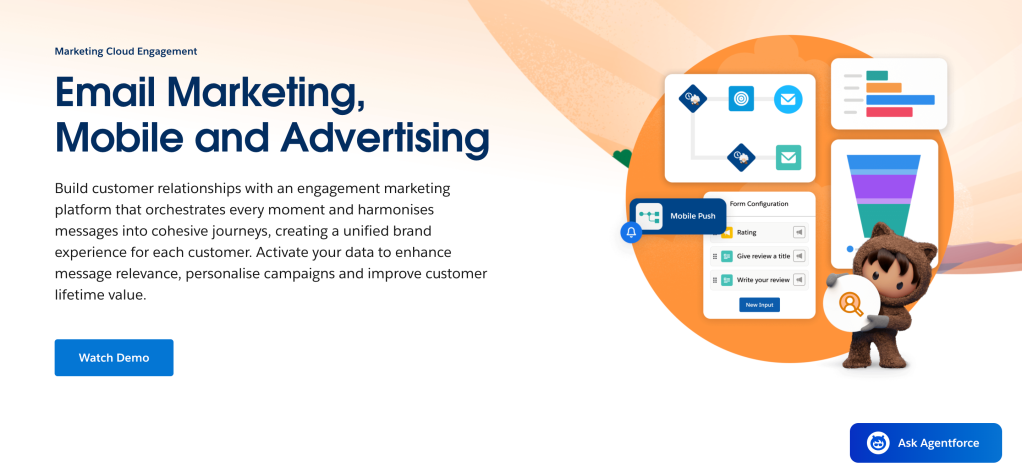
Salesforce’s Agentforce Marketing (formerly Marketing Cloud Engagement) gives you the tools to build, personalise, and automate email campaigns with real-time data from your CRM. It supports large-scale content creation and AI-driven journey optimisation so teams can run more targeted campaigns with less manual setup.
Key strengths
- Reusable content blocks for consistent email creation
- Real-time reporting across sends, engagement, and contact data
- AI-powered content suggestions and automated journeys
- Strong segmentation through CRM-connected customer profiles
Limitations: The platform is powerful, but it costs more due to its advanced features. Smaller teams may also need time and support to set everything up correctly.
Pricing: Starts at around $1,750/month.
Best for: Mid-sized and enterprise teams that want advanced personalisation and CRM-connected marketing workflows.
If you want to explore how the AI agents and automation work in practice, you can try it free for 30 days.
2. Brevo
Brevo is an all-in-one marketing platform designed for small businesses that need an affordable but capable way to manage email, SMS, and simple CRM activity. It supports automated campaigns, segmentation, and A/B testing without requiring complex setup.

Image source: Brevo
Key strengths
- Email and SMS marketing in one place
- Built-in CRM for basic contact management
- Easy-to-use automation and segmentation tools
Limitations: Templates and CRM features can feel limited for teams that need deeper customisation or more advanced customer data tools.
Pricing: Offers a free plan, with paid plans starting at $9/month.
Best for: Small businesses and startups that want a budget-friendly email platform with simple automation.
3. Mailtrap
Mailtrap is a modern email platform built for product and marketing teams that care about high deliverability, reliable infrastructure, and deep analytics. Tailored for high sending volumes, Mailtrap combines email marketing, transactional email, and bulk sending.

Image source: Mailtrap
Key strengths
- High deliverability with detailed reporting on opens, clicks, bounces, and spam issues
- Drag-and-drop editor, AI content suggestions, and flexible templates
- GDPR-compliant and ISO 27001-certified
Limitations: The interface can feel more technical than traditional marketing platforms.
Pricing: Free plan available with paid plans starting at $15/month.
Best for: Product and marketing teams that send out high-volume emails and want strong data-driven insights.
4. ActiveCampaign
ActiveCampaign is a marketing automation powerhouse that blends email marketing with advanced automation and CRM functionalities. It excels in providing prebuilt automation workflows that help businesses nurture leads, re-engage inactive customers, and drive conversions with minimal effort.

Image source: ActiveCampaign
Key strengths
- Prebuilt automation workflows for quick setup
- Strong segmentation and behavioural targeting
- Multi-channel automation across email, SMS, and site messaging
Limitations: Some users say the platform can feel a bit restrictive when setting up more detailed campaigns.
Pricing: Plans start at $23/month.
Best for: Teams that want deeper automation and data-driven campaigns without the complexity of enterprise-sized tools.
5. Moosend
Moosend is an affordable email platform built for teams that want simple, yet powerful, automation. It includes AI writing support, a drag-and-drop editor, ready-made templates, and basic behavioural triggers.

Image source: Moosend
Key strengths
- Easy to use with minimal setup
- 130+ templates and automation workflows
- Behaviour-based segmentation and custom reporting
Limitations: Direct integrations are limited, and some users find advanced options harder to find.
Pricing: Free 30-day trial with paid plans starting at $9/month.
Best for: Small businesses and beginners who want an inexpensive email platform that still offers built-in AI and automation.
6. Klaviyo
Klaviyo is a data-driven email marketing software that is flexible and tailored specifically for ecommerce businesses. It offers integrations with platforms like Shopify and Magento to help you use real-time customer behaviour and purchase data for highly personalised campaigns.

Image source: Klaviyo
Key strengths
- Deep ecommerce integrations with platforms like Shopify and Magento
- Real-time behavioural data for personalised campaigns
- Strong automation for basket abandonment, product flows, and re-engagement
Limitations: The platform is powerful, but some users find the learning curve steeper than expected.
Pricing: Free version available, with paid plans starting at USD $45/month.
Best for: Ecommerce brands that need automated customer journeys.
7. MailerLite
MailerLite is an easy-to-use email marketing solution that focuses on simplicity while still offering powerful features. With a drag-and-drop editor, over 150 email templates, advanced automation options, and built-in customer support tools, MailerLite is perfect for businesses looking for a user-friendly platform that delivers strong engagement results.

Image source: MailerLite
Key strengths
- A beginner-friendly editor with over 150 templates
- Landing pages and pop-ups built in
- Clear automation tools for welcome flows and ongoing engagement
Limitations: More advanced automations and design customisation can feel limited for teams needing deeper control.
Pricing: Free version available, with paid plans starting at $7.50/month.
Best for: Small businesses and early-stage ecommerce brands that want an affordable platform.
8. Mailchimp
Mailchimp is a popular email marketing tool known for its user-friendly interface and comprehensive feature set. It provides businesses with a drag-and-drop email editor, prebuilt templates, and automation tools that simplify campaign creation. Mailchimp has over 300 integrations and a 98% delivery rate.

Image source: Mailchimp
Key strengths
- Large library of customisable templates
- Easy-to-use editor and simple automations
- Strong integrations with ecommerce and marketing tools
Limitations: Pricing can increase quickly as your audience grows, and some advanced automation features are limited to higher plans.
Pricing: Free for 14 days, then starts at $30.42/month.
Best for: Small to mid-sized businesses that want a platform to create and send professional, well-designed emails.
9. HubSpot
HubSpot is a powerful software option integrated within its all-in-one CRM, which lets businesses create personalised and data-driven campaigns. It offers advanced automation, in-depth analytics, and easy integration with sales and customer service tools, especially if you’re already using HubSpot for sales.

Image source: HubSpot
Key strengths
- User-friendly editor with automation tools
- Built-in CRM data for simple segmentation
- Large range of integrations for websites and sales tools
Limitations: Costs escalate quickly as your contact list grows, and many useful features (like advanced automation or A/B testing) sit behind higher-priced tiers.
Pricing: Starts at $780/month.
Best for: Small to mid-sized teams that want an all-in-one platform but don’t need complex automation.
10. GetResponse
GetResponse is a versatile email platform that bundles email marketing with extras like landing pages, simple automation, and even a website builder. It’s easy to use and has a reputation for strong customer support, which is helpful for small teams that need quick answers.

Image source: GetResponse
Key strengths
- Includes landing pages, automations, and basic funnels
- Beginner-friendly builder with AI-assisted templates
- Helpful and responsive support team
Limitations: Some features feel limited, and their price increases quickly as your contact list grows.
Pricing: Offers a free plan, then paid options from $19/month.
Best for: Small businesses that want an all-in-one tool without the need for automation.
11. Omnisend
Omnisend is an email and SMS marketing platform designed for ecommerce businesses looking to improve their customer engagement. It works well with popular ecommerce platforms like Shopify and WooCommerce and allows small online retailers to create highly personalised and revenue-driven campaigns.

Image source: Omnisend
Key strengths
- Built-in workflows for cart recovery, product recommendations, and post-purchase
- One-click product imports from Shopify and WooCommerce for fast email building
- Strong segmentation tools based on real purchase behaviour
Limitations: Some users find the billing tiers confusing, and design flexibility can feel limited if you want full creative control.
Pricing: Free plan available, with paid plans starting from $16/month.
Best for: Ecommerce stores that want revenue-focused automation without a steep learning curve.
12. Constant Contact
Constant Contact is an email marketing tool designed to help non-profits and small businesses that need simple tools for newsletters, events, and community engagement. It includes customisable templates, event management, donation options, and basic social posting.

Image source: Constant Contact
Key strengths
- Easy-to-use editor suitable for beginners
- Event management and donation tools are built into the platform
- Solid list segmentation for targeting different audience groups
Limitations: Template and design flexibility can feel limited, and it isn’t suitable for growing businesses.
Pricing: Free 14-day trial, then plans start from $18/month.
Best for: Non-profits and small organisations that want a simple way to manage their emails.

Stay up to date on all things marketing.
Sign up for our newsletter to get the latest research, industry insights, and product news delivered straight to your inbox.
How to get started with Agentforce Marketing
If you want to use the email marketing software that helped R.M.Williams achieve 3.5 times higher open rates and two times higher conversion rates from targeted emails, try Agentforce Marketing.

To understand how the tool could help your business, start with a free demo. You’ll see how AI and real-time CRM data come together to build personalised journeys, adapt content based on customer behaviour, and generate reports on your email results in real-time.
FAQs
The best email marketing platform is one that aligns with a business's specific needs, offering features like automation, segmentation, personalisation, analytics, and user-friendliness for effective campaigns.
Essential features include robust email automation, advanced segmentation, drag-and-drop editor, A/B testing, CRM integration, comprehensive analytics, and reliable deliverability.
How does an email marketing platform improve campaign ROI?
By enabling targeted messaging, automation, and performance tracking, a good platform helps optimise campaigns, leading to higher engagement, conversion, and a better return on investment.
Yes, leading platforms are designed to manage large subscriber lists, offering scalable solutions and ensuring high deliverability rates even for extensive campaigns.
Integration with CRM, ecommerce, and other marketing tools is crucial for a unified customer view, seamless data flow, and consistent cross-channel customer experiences.
It enables personalisation through dynamic content, segmentation, and behaviour-triggered emails, allowing marketers to send highly relevant messages to individual subscribers.
Keep up with the latest marketing trends, insights, and conversations.


Ready to take the next step?

Talk to an expert.
Tell us a bit more so the right person can reach out faster.

Stay up to date.
Get the latest research, industry insights, and product news delivered straight to your inbox.
