AI supported the writers and editors who created this article.

AI supported the writers and editors who created this article.

A headless CMS is a content management system that separates the content repository from the presentation layer, storing content as structured data and delivering it to any front end or channel via API.


By Sara Fefferman, Senior Product Marketing Manager
Traditional CMS platforms couple content to presentation templates — a model built for web pages that breaks down the moment content needs to reach mobile apps, voice interfaces, digital signage, AI-powered surfaces, or multiple brands simultaneously. A headless CMS was designed to solve that.
Brands today publish content to websites, mobile apps, digital signage, voice assistants, and ecommerce storefronts. A headless CMS makes that possible from a single content repository — one place to create, one API to deliver everywhere. For teams evaluating whether headless is the right move, this guide covers what it is, how it works, and when it makes sense, for both technical and marketing audiences.
A headless CMS separates the content repository from the front-end presentation layer. Content is stored as structured data and delivered via API — independent of how or where it will be displayed.
In a traditional content management system, content and presentation live inside the same system. Change the content, and the template changes with it. A headless content management system puts an end to that dependency.
The term "headless" refers to removing the "head" — the front-end display layer — from the body of the CMS. What remains is a structured content repository that stores entries as data, independent of how or where they'll be displayed. A developer's front-end application requests that content via REST APIs, GraphQL APIs (or both) and renders it according to its own design rules.
At the center of any headless CMS is the content model: a set of structured content types that define the fields, relationships, and formats for every entry. Because those types carry no visual assumptions, the same content entry can render differently depending on the channel consuming it.
The main difference between a headless CMS and a traditional one is in the presentation. Traditional CMS keeps content management and presentation linked in one system, while headless allows you to separate content management from presentation. Choosing between a headless and a traditional CMS comes down to your channel complexity, your team's technical resources, and how you plan to reuse content over time. Neither architecture is universally superior — the right answer depends on what you're building.
The headless CMS workflow separates three distinct stages that a traditional CMS compresses into one. Understanding each stage clarifies why headless architecture gives teams more flexibility at scale.
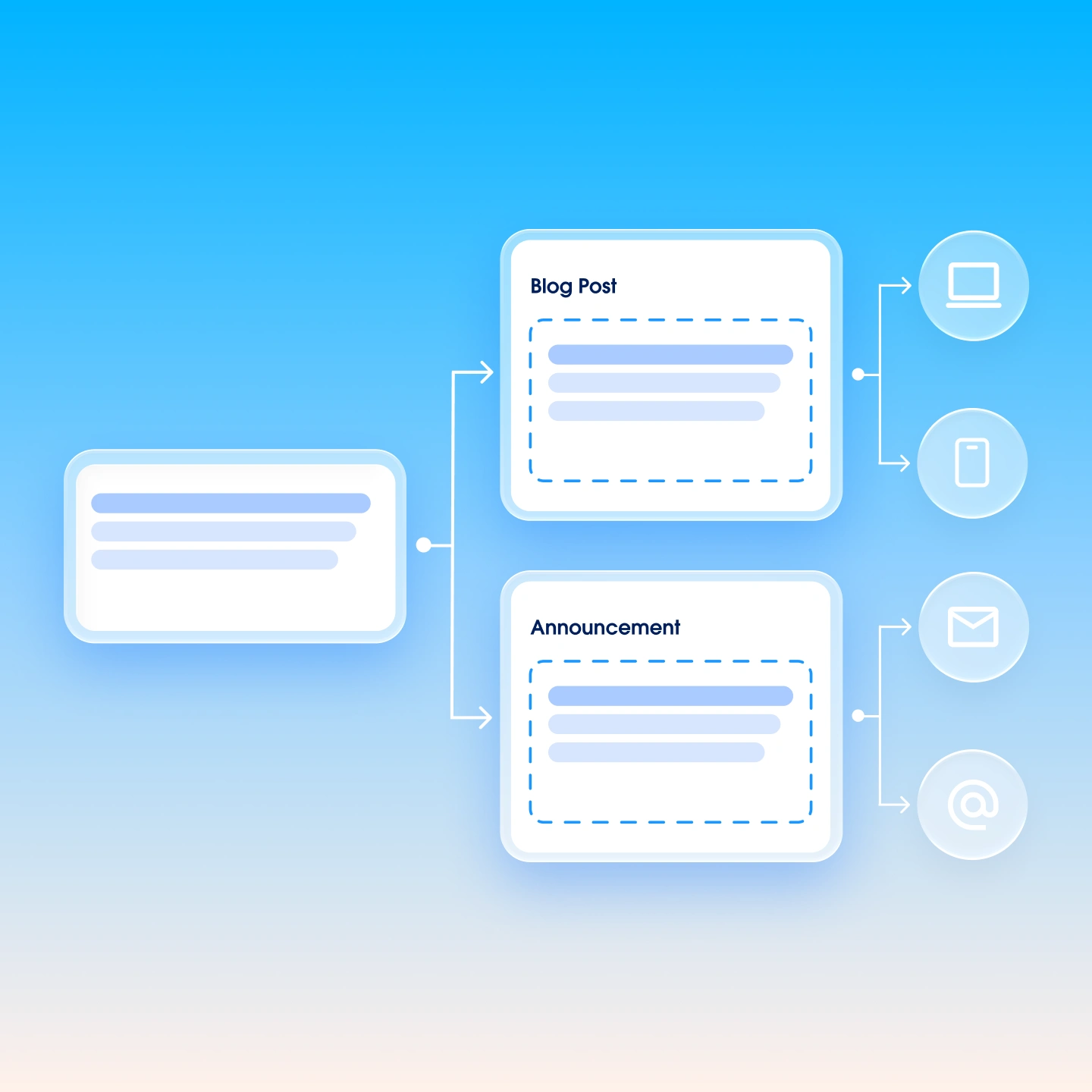
Step 1 — Create: Content authors build and structure entries in the CMS back end using predefined content types. A "product description" entry, for example, might include fields for a title, body copy, image reference, and metadata. Authors work in the back end only without having to map out how the content will eventually look.
Step 2 — Store: The CMS saves that entry as structured data — not attached to any visual template. The entry exists as a clean, portable object in the content repository.
Step 3 — Deliver: A front-end application or delivery layer sends an API request to the CMS and receives the structured content in response. That application applies its own design, layout, and formatting rules before rendering the content to the end user.
The result: the same product description can appear on a website, inside a mobile app, as a voice assistant response, or on a digital kiosk — without the content team re-authoring a single word.
The case for headless is strongest when teams are managing content across multiple channels, brands, or surfaces. According to the 2026 State of Marketing report, 78% of marketers say they need more personalized content than they're able to produce. A headless CMS addresses that gap by making content reuse a structural feature rather than a workaround, selectively serving content according to known characteristics of your audience.
Omnichannel delivery — publish once, deliver everywhere. Because content is stored as structured data and served via API, a single entry reaches any channel without duplication.
Content reuse at scale. One content entry can power a product page, a mobile app screen, an email campaign, and a digital sign without the content team touching it more than once. For organizations managing multiple brands or markets, that efficiency adds up quickly.
No ceiling on the front-end experience. The CMS imposes no presentation layer, so teams build in any language and apply any design pattern without inheriting constraints from a template system. There is no ceiling on what the front end can do — the experience is bounded only by what the team designs, not by what the CMS supports.
Faster performance. Headless architectures pair well with static site generation and edge delivery, which can reduce page load times meaningfully. The presentation layer is purpose-built for performance, not assembled from CMS templates.
Future-ready channel expansion. Adding a new channel — a smartwatch app, a voice interface, a new regional site — means building a new front end that connects to the existing API. The content model stays the same.
Independent team velocity. Developers and content editors work in parallel without blocking each other. Editors add content; developers update the front end. Neither workflow depends on the other.
Security advantage. Headless architectures can reduce certain security risks by decoupling the content repository from the public-facing application and minimizing direct exposure of the CMS.
"Headless," "decoupled," and "hybrid" appear in vendor marketing as near-synonyms, but they describe meaningfully different architectural models. Getting the distinction right matters when evaluating platforms.
Headless CMS: Stores content as structured data and delivers it exclusively via API. There is no built-in presentation layer — the front end is built and maintained separately, independent of the CMS.
Decoupled CMS: Separates content management from the front end but retains a built-in web presentation layer for page rendering. Content can be delivered traditionally — rendered by the CMS — or via API to external front ends. The difference from headless: there is a CMS-side web layer, even if it is not the only delivery path.
Hybrid CMS: Supports both traditional page-building and API-based delivery from one platform. Editors can use WYSIWYG tools to build web pages directly, while the same content is also available via API to other channels. Neither purely decoupled nor purely headless — it combines both delivery modes.
Headless architecture enables some content use cases that a traditional CMS handles poorly or not at all. The two highest-value use cases for teams already running omnichannel marketing or commerce workflows are personalization and ecommerce content — both benefit from API delivery in ways that go beyond basic channel flexibility.
E-commerce product and landing page content. A headless CMS lets commerce and content teams work in their respective systems while delivering coordinated experiences. Agentforce Commerce can consume structured product content from the CMS via API, so content updates propagate to the storefront without a deploy. Content and commerce stay in sync without shared infrastructure.
Personalizing content based on user data. Structured content with profile data from a customer data platform lets the delivery layer assemble the right variant before it reaches the visitor. One segment sees one version of a landing page, another sees a different one, from the same content entries. Because the variant resolves server-side or at the edge rather than being swapped in the browser, there's no visible flicker and crawlers see complete content.
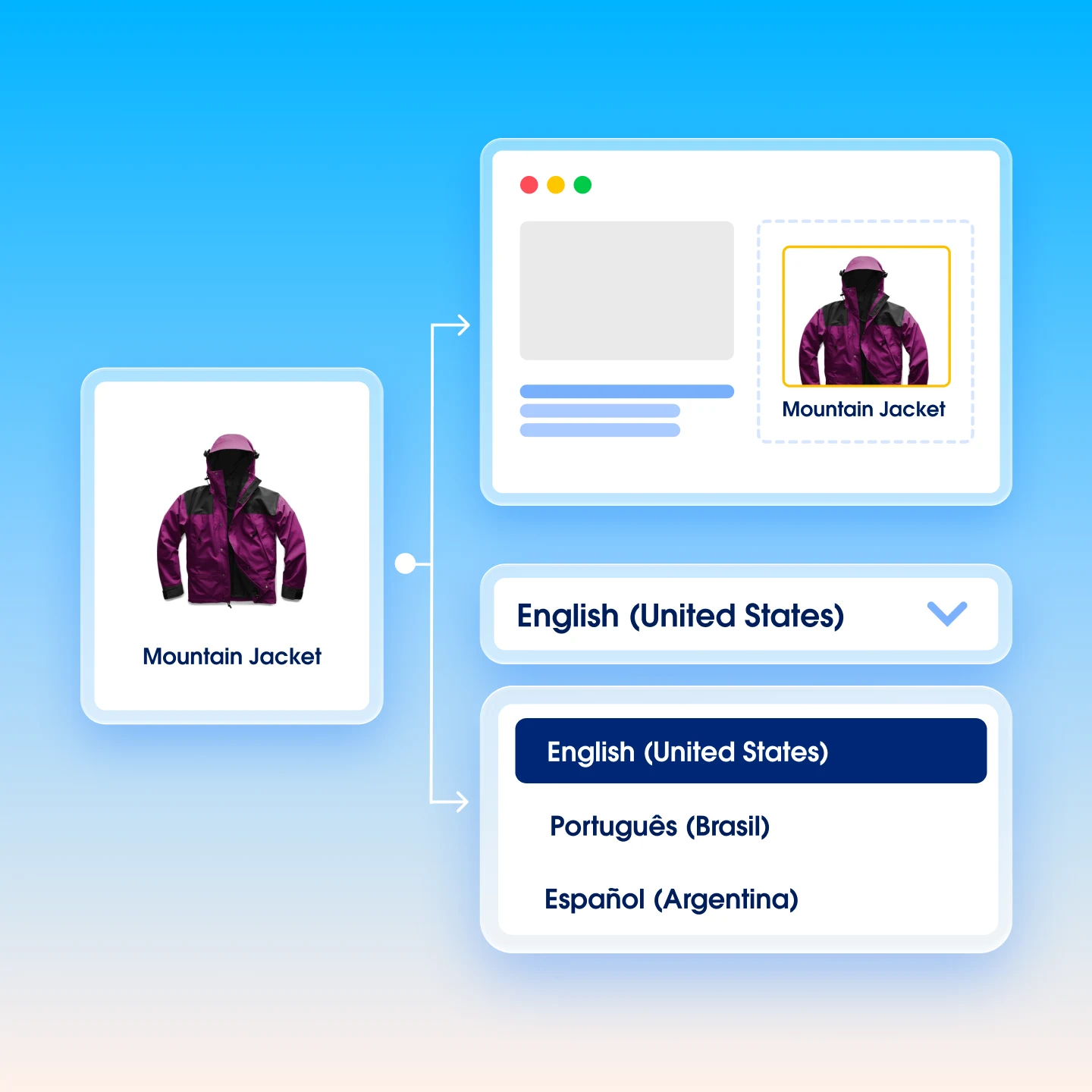
Multi-site or multi-brand content management. A single content repository feeds multiple websites and brands without duplicating entries or managing separate systems. Translations and regional variations live in the same model.
Mobile app content delivery. APIs deliver structured content directly to app front ends. When a content editor updates an entry, the update appears in the app without a new release.
Digital signage and kiosk content. Any screen with an API can consume headless content. Retail and venue environments benefit from centralized content management across locations.
Localization and multilingual delivery. Structured content models make translation workflows significantly more consistent. Regional variations are managed inside the same content type, not across separate systems.
Headless architecture pays off at scale. Before that point, there's differences in how marketers or teams may be used to working with content development.
Higher front-end development investment. A headless CMS delivers no presentation layer. Preview workflows and front-end rendering all require custom builds. Teams without dedicated front-end engineering resources will feel this cost most.
Change in marketer experience: Authors work in structured fields rather than page templates, which is a change in habit for teams used to editing pages directly. Preview and visual editing are configured once against the front end, so the cost is in setup rather than in day-to-day authoring. Without setting up that preview environment or visual editor, content authors lose the visual feedback they're used to. This may require planning and maintenance.
Intentional content model governance required. As more teams and channels consume the same content model, managing content types, field definitions, and publishing workflows becomes a discipline of its own. Without clear ownership, the model drifts.
Integration overhead. Connecting a headless CMS to analytics platforms, personalization engines, and commerce systems requires clear requirements and initial engineering work. The overhead is primarily in planning and mapping integrations correctly at the start rather than in ongoing maintenance. AI-assisted tooling has reduced some of these barriers, though upfront requirements clarity remains essential.
Headless is the right fit when content complexity justifies the upfront investment. If you have multiple channels, markets, or brands for example. Or, if you have content that needs to appear in more than one context without re-authoring and a team with front-end development capacity.
Four practical criteria can help you determine if that investment is worth it:
Content complexity: If the same content has to appear across multiple channels, markets, brands, or personalized variants, without re-authoring, the cost of maintaining it in a page-based system rises faster than the cost of building the front-end experience.
Front-end freedom: No presentation constraints. Any language, any design pattern, built independently of the CMS. This is great if your development team wants front-end framework freedom.
Content reuse as an efficiency goal: If the same content — product descriptions, support articles, marketing automation copy — needs to appear across multiple contexts without re-authoring, a headless content model handles that more efficiently than any other architecture. This is also important if your organization plans to add new channels over the next one to two years.
Workflow compatibility: If you're building or extending an ecommerce or personalization workflow that depends on structured content, a headless CMS may make that easier.
For genuinely simple sites — single channel, limited content scope, no multi-market or multi-brand requirements — a traditional CMS delivers sufficient capabilities with less initial complexity. The calculus shifts as content requirements grow.
A headless CMS is a foundational piece of composable commerce and the broader composable architecture model. Rather than relying on a single monolithic platform, composable architecture assembles best-of-breed tools — each with a defined scope — connected via APIs. The headless CMS contributes content as a service: structured, portable, and available to any system that requests it.
In this model, the headless CMS integrates with a digital experience platform, customer data platform, or commerce platform to deliver connected experiences at scale. The content layer stays separate from the data and personalization layers, but they work together through shared APIs. According to the 2026 State of Marketing report, 86% of marketers say AI is raising customer expectations — which means the platforms organizations rely on need to adapt quickly. A composable, API-first architecture is better positioned to absorb that change than a tightly coupled monolith.
A traditional CMS stores content and presentation together in a single system — content is tied to templates, and publishing means rendering pages the CMS controls. A headless CMS stores content as structured data and delivers it via API to any front end. The content exists independently of how or where it's displayed.
Probably not for genuinely simple sites. A single site with a small team, one channel, and no localization or personalization requirements is well served by a traditional or hybrid CMS with less upfront complexity. The calculation changes for sites running multiple markets, languages, sub-brands, or personalized variants: even a single domain with that kind of content complexity faces the same reuse problem as a multi-channel estate, and benefits from the same structured approach.
Because content is stored as structured data and served via API, the same entry reaches any channel that can make an API request — a website, a mobile app, a voice interface, digital signage, or an ecommerce storefront. There's no need to duplicate or re-author content for each surface. This is the core architectural advantage of a headless content management system over a traditional one.
A headless CMS has no presentation layer at all — it delivers content exclusively via API and has no concept of how content will look when rendered. A decoupled CMS retains a web presentation layer for page rendering but also exposes an API for external front ends. The terms are often used interchangeably in vendor materials, but the distinction matters when evaluating which architecture fits your workflow.
Initial setup and content model configuration typically require a developer. After that, marketers author, update, and publish independently. Live preview and visual editing are configured against the front end. What changes from a traditional CMS is that authors work in structured fields rather than page templates, which is a shift in habit rather than a lasting capability gap. Marketing teams can also use AI tools and LLM-connected workflows, including native MCP server integrations available in enterprise headless platforms, to streamline content model setup and content operations. Developer involvement remains valuable for initial configuration and front-end maintenance.
Composable architecture is an approach to building digital infrastructure by assembling best-of-breed tools connected via APIs, rather than deploying a single monolithic platform. A headless CMS fits in as the content-as-a-service layer — providing structured content that any connected system can consume. Paired with a headless guide and the right API integrations, it becomes a durable foundation for adding new channels and experiences without rebuilding from scratch.